
Virtual Reality for companies: experiences, training and immersive simulators
Nexus develops tailored Virtual Reality solutions for companies, combining strategy, UX, 3D development and implementation for training, simulators, sales, events, onboarding and brand experiences.
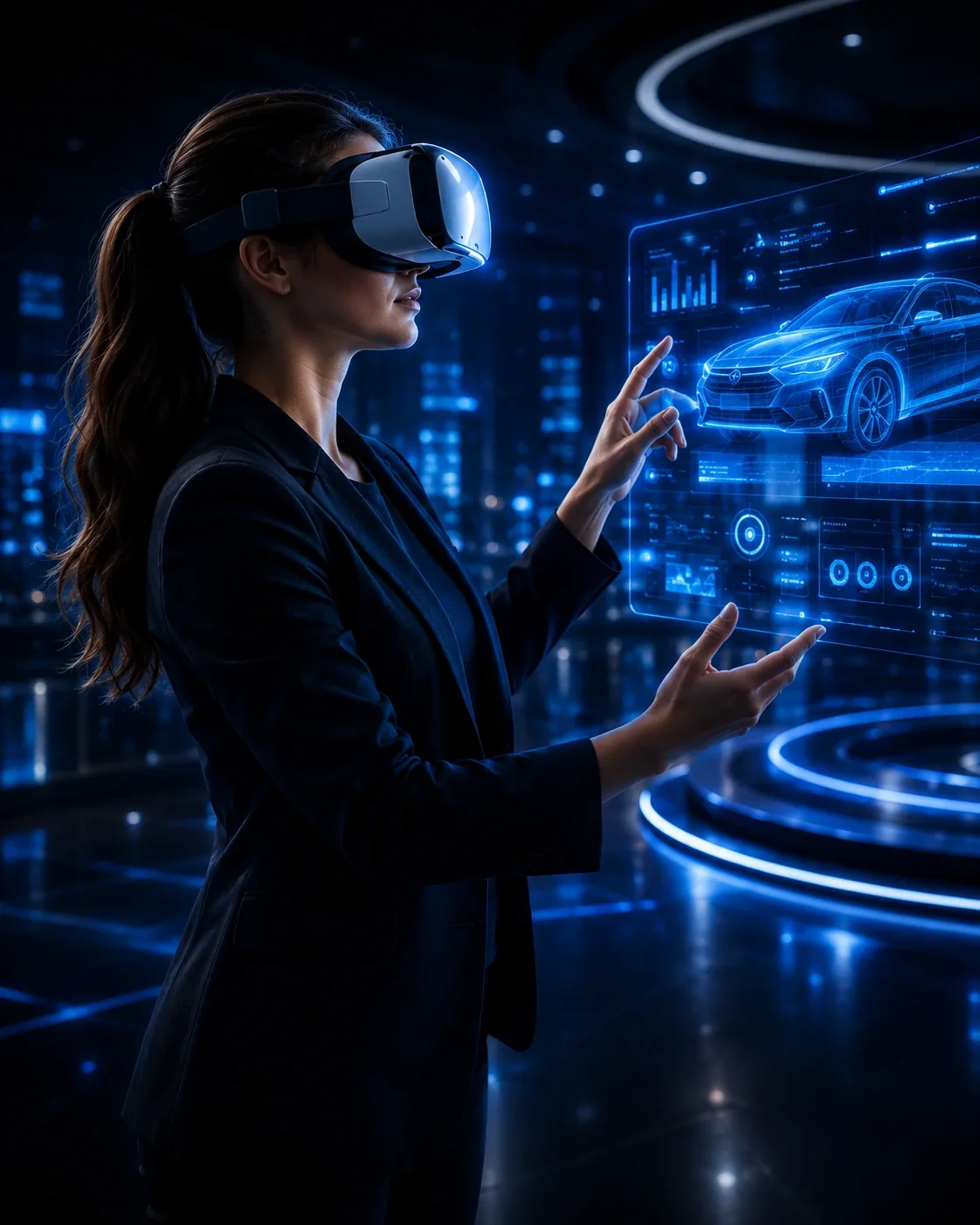
What is Virtual Reality and when to use it?
Virtual Reality creates an immersive digital environment in which the user can observe, navigate and interact with real-scale objects, processes and scenarios. In corporate projects, technology is used when it is important to simulate presence, repetition, spatial interaction or situations that are difficult to reproduce physically.
In practice: Projects can operate on standalone headsets, PC VR or mixed reality experiences. The architecture is defined according to graphic fidelity, mobility, number of users, need for tracking, integration with peripherals and learning indicators.
Where this solution generates value
Technical and operational training with controlled scenarios
Allows you to practice procedures in an immersive environment designed to reproduce context, sequence and spatial interaction, with the possibility of repetition without interrupting the real operation.
Machine, vehicle, safety and procedure simulators
Recreates controls, behavior and operational situations so that the user practices decisions and steps before executing the activity on the real equipment or environment.
Commercial presentations and demonstrations of complex products
Large products, environments and systems can be presented at an immersive scale even when they are not physically available at the meeting or event location.
Brand activations, fairs and event experiences
VR transforms campaigns and launches into participatory experiences, combining narrative, interaction and spatial presence into a measurable and replicable activation.
Onboarding and training with immersive content
Environments, processes and routines can be presented in a contextual way to accelerate employee familiarization with facilities, products and procedures.
From challenge to deployment
Discovery
Objective, audience, environment, KPI and technical restrictions.
Experience design
Journey, interaction, content and product architecture.
Development
Software, 3D, integrations, hardware and validation.
Deploy and evolution
Deployment, support, analytics and continuous updating.
Questions about Virtual Reality
What companies use Virtual Reality for?
Mainly for training, simulation, commercial presentation, events, onboarding, security and visualization of products or complex environments.
Is it necessary to use a computer?
Not necessarily. Many projects can run on standalone headsets; Applications with advanced graphics or peripherals can use a dedicated PC.
How much does a VR project cost?
The investment depends on the number of scenarios, level of 3D modeling, interactions, integrations, hardware and need for field operation. The scope is defined before production.
Does VR work for corporate training?
Yes. Technology is especially suitable when training requires spatial context, repeated practice, risk simulation or standardization of procedures.
Related content
Do you want to transform this concept into a solution applied to your business?
Talk to our team about goal, environment, content, hardware, integrations and deployment scale.
Talk to an expert →