
Augmented Reality for Business: Products, Operations, and Real-World Experiences
Nexus creates Augmented Reality experiences that overlay digital content on the real environment to visualize products, guide tasks, activate campaigns, train teams and transform smartphones, tablets and spatial devices into interactive interfaces.
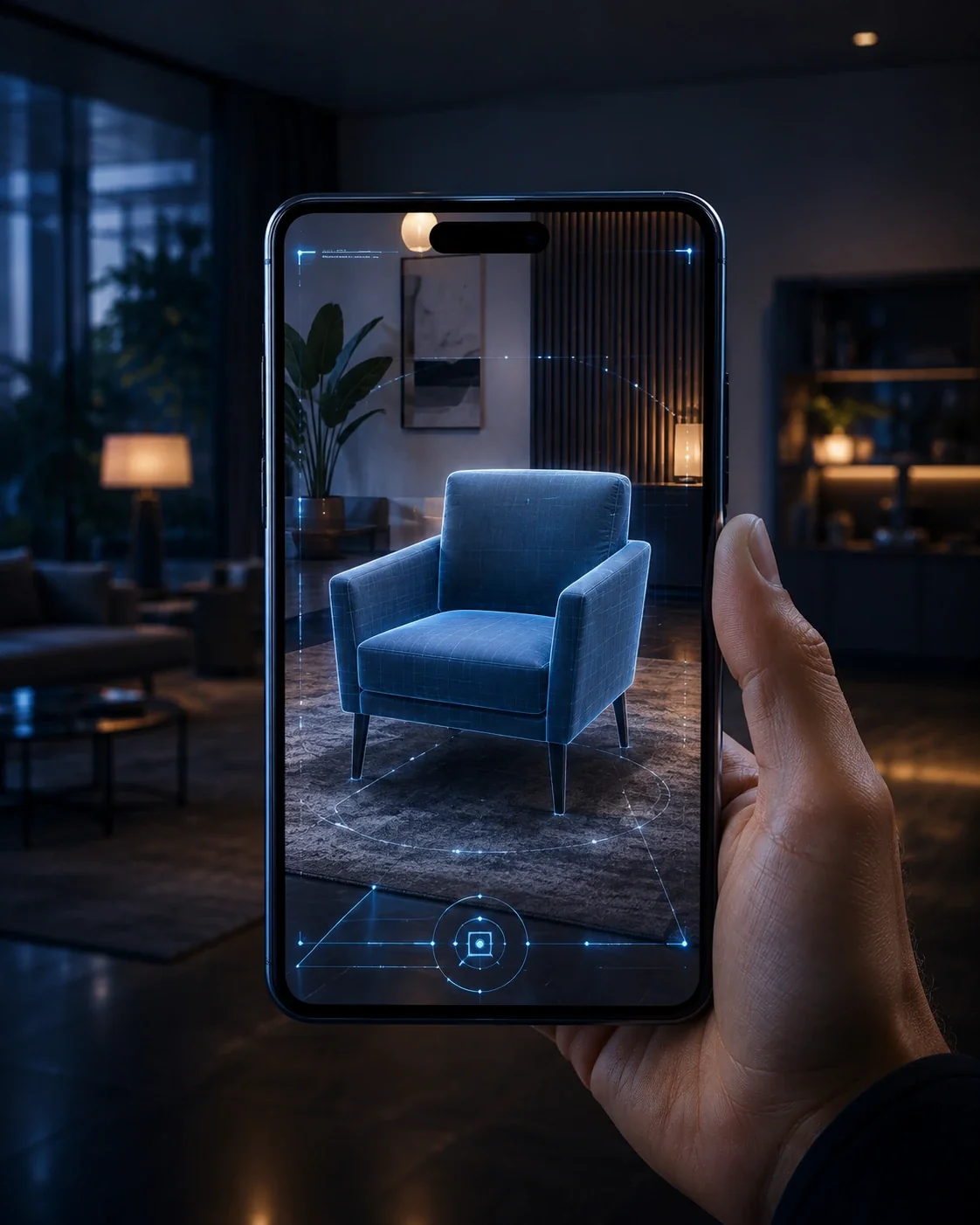
What is Augmented Reality and when to use it?
Augmented Reality keeps the user in the physical environment and adds digital layers — 3D objects, information, animations, interfaces and instructions — aligned with the real context. It is indicated when the value is in relating digital information with an existing product, space or process.
In practice: The solution can be delivered via app, WebAR or spatial computing devices. Tracking, image recognition, surface and markers are chosen according to stability, campaign reach and necessary precision.
Where this solution generates value
Full-scale product preview before purchase
3D models can be positioned in the user's environment to evaluate proportion, space occupation, appearance and different configurations before making a purchasing decision.
Instructions and visual support for maintenance or operation
Digital elements can indicate components, steps and information directly on the equipment or work area, reducing dependence on out-of-context instructions.
Experiences in packaging, print media, POS and events
QR Codes, images and surfaces can act as entry points for 3D content, videos, games, animations and product information.
Contextual training on real equipment
The team keeps the physical equipment visible and receives digital layers of guidance, identification and sequence of procedures on the work context itself.
Presentation of 3D models on smartphones and tablets
Products that do not fit in the physical space can be demonstrated at scale and with interaction using devices already familiar to the user.
From challenge to deployment
Discovery
Objective, audience, environment, KPI and technical restrictions.
Experience design
Journey, interaction, content and product architecture.
Development
Software, 3D, integrations, hardware and validation.
Deploy and evolution
Deployment, support, analytics and continuous updating.
Questions about Augmented Reality
What is the difference between AR and VR?
VR replaces the vision of the environment with a virtual space; AR keeps the real world visible and adds digital content on top of it.
Does Augmented Reality need an app?
No. In many cases it is possible to use WebAR directly through the smartphone's browser, although some advanced projects still benefit from native applications.
Does AR work at events?
Yes. It can be used in activations, product demonstrations, interactive scenarios, games and experiences connected to physical materials.
Is it possible to view products in full size?
Yes, as long as the 3D model is prepared and the device has adequate capabilities for surface tracking and scale.
Related content
Do you want to transform this concept into a solution applied to your business?
Talk to our team about goal, environment, content, hardware, integrations and deployment scale.
Talk to an expert →