
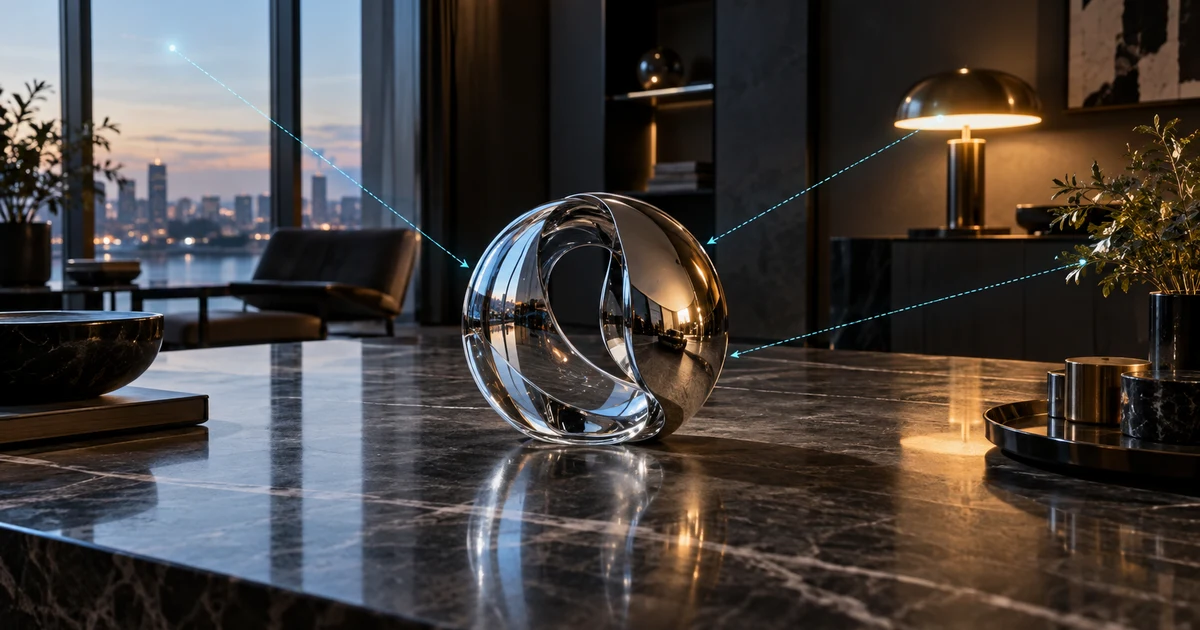
The API provides direction, intensity, spherical harmonics, and reflections for XR compositing. Understand realism, performance and privacy.
Direct answer
WebXR Lighting Estimation API Level 1 defines how an immersive web experience can receive ambient lighting estimates. The interface includes key light direction and intensity, spherical harmonics for diffuse light, and a cubic map for reflections. This data helps virtual objects appear part of real space, but they are low frequency and resolution estimates, device dependent, and require the optional light-estimation feature in the XR session.
Light coherence increases presence
Direction, color and intensity similar to the environment make shadows and volumes more plausible. The goal is not perfect photometric reproduction, but to reduce visual contradictions.
Harmonics represent diffuse light
Compact coefficients describe low-frequency lighting around the object. Materials and shaders need to interpret data in a way that is consistent with the graphics engine.
Reflexes require budget
The cubic map approximates the surroundings in specular surfaces, but updating and filtering have a cost. Frequency must follow perceptual need, not each frame by default.
Support is optional and should degrade well
The application needs to detect the resource and maintain neutral lighting when it does not exist. Essential content cannot rely solely on estimation.
Nexus Reading
Lighting estimation delivers value when materials, art direction and performance are treated together. Tests should compare perceived realism, stability, and cost on target devices.
FAQ
Does the API measure lighting with professional accuracy?
No. It provides appropriate estimates of the visual composition, with frequency and resolution limitations.
Does every WebXR browser support it?
No. The feature is optional and must be requested and detected by the application.
What to do without support?
Use coherent fallback lighting and preserve all essential functionality of the experience.
Essential guides to delve deeper into the decision
This editorial analysis was produced by Nexus from the official sources below, consulted on September 17, 2026. The text is original and interprets practical implications for companies.
- W3C — WebXR Lighting Estimation API Level 1: interfaces, light model, harmonics, reflection cube map, permissions and privacy considerations.
- W3C — WebXR Device API: normative model of sessions, frames, spaces and resources in which the lighting module is integrated.
Date reported by main source: W3C specification consulted on September 17, 2026; technical analysis.