
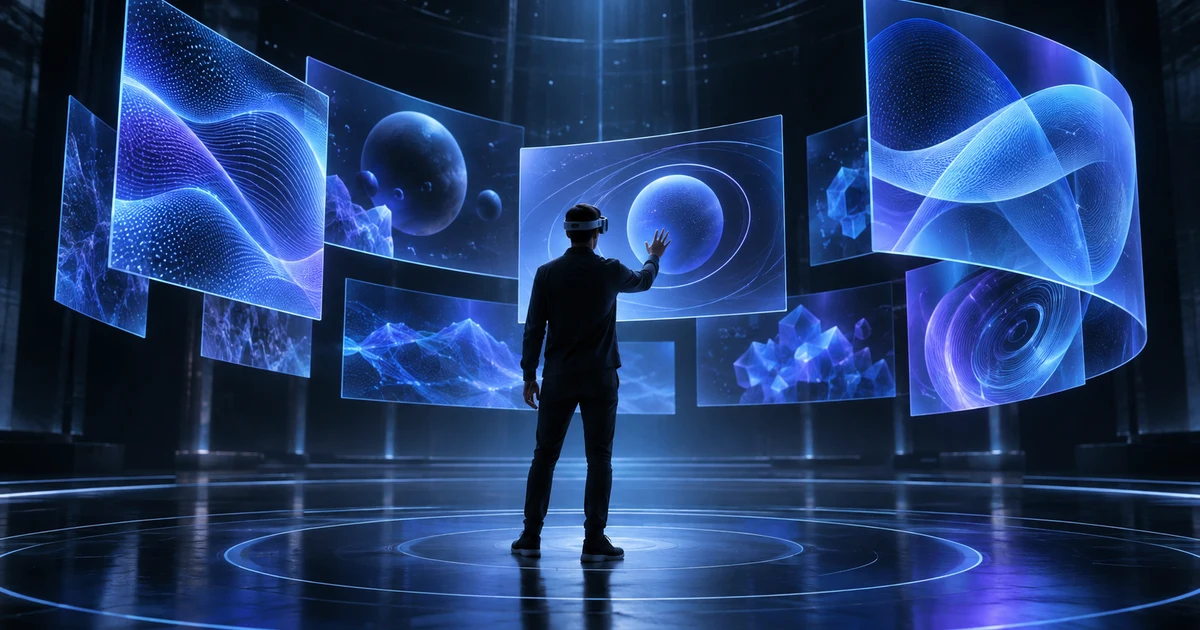
The proposal allows quad, cylinder, cubemap and media layers composed by the runtime. See performance, readability, support, and fallback.
Direct answer
The WebXR Layers API allows you to send specialized layers such as flat frames, cylinders, cubemaps, and media to the device composer in addition to the main projection. Interfaces and videos can gain clarity and avoid part of the cost of rendering everything within the 3D scene. Because the specification is a draft from the Immersive Web Community Group and support is optional, products must detect the feature and maintain conventional rendering as a fallback.
Composer can preserve detail
Text, panels, and video do not need to share exactly the same scene buffer. A dedicated layer can maintain better resolution and filtering.
Layer geometry follows content
Quad works for flat screens, cylinder wraps the field of view and cubemap serves environments. The wrong choice can distort reading and scale.
Lower cost is not automatic
Texture changes, number of layers and resolution continue to consume resources. The gain must be measured on the target device and browser.
Fallback maintains range
Without layer support, the application must compose the same content in the main projection, preserving function even with less clarity or efficiency.
Nexus Reading
Layers is a visual architecture tool for web XR. It is valid when it improves a critical metric, such as readability, video or frame time, with explicitly tested fallback.
FAQ
What content can use layers?
The proposal includes projection, quad, cylinder, equirectangular, cubemap and media layers, depending on support.
Do layers always improve performance?
No. The benefit depends on the composer, resolution, number of layers and update pattern.
What to do without support?
Render content within the main projection layer and maintain functional equivalence.
Essential guides to delve deeper into the decision
This editorial analysis was produced by Nexus from the official sources below, consulted on September 20, 2026. The text is original and interprets practical implications for companies.
- Immersive Web — WebXR Layers API Level 1: layer types, bindings, composition, layout, textures and composer behavior.
- W3C — WebXR Device API: main session, frame and projection model on which Layers integrates.
Date reported by main source: technical draft consulted on September 20, 2026; analysis.