
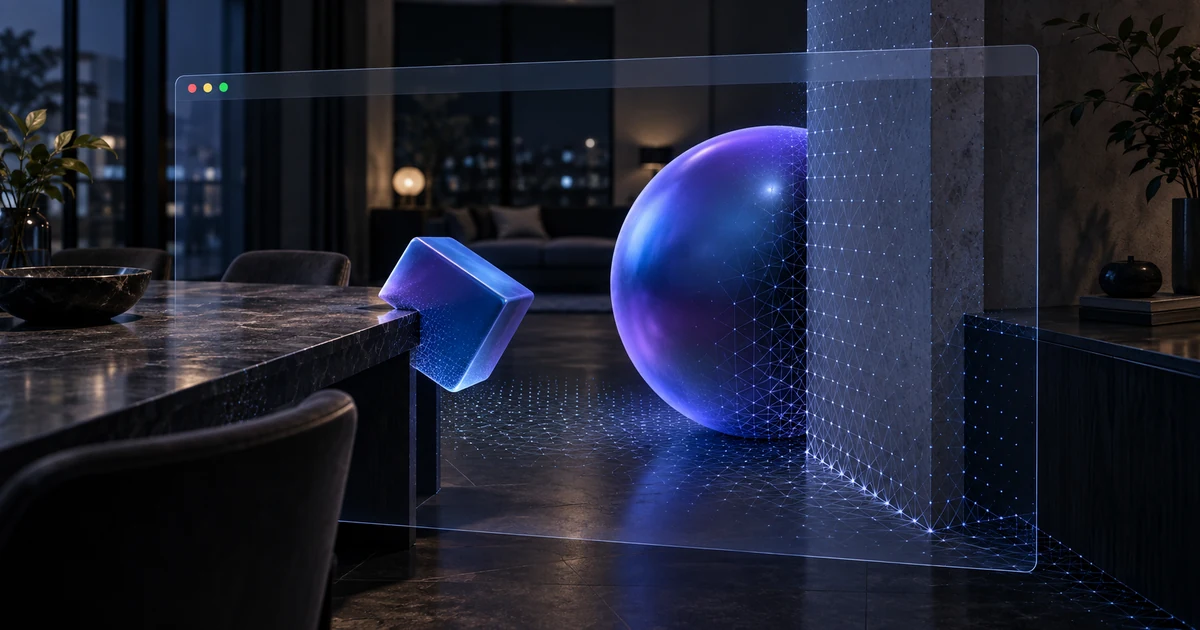
The W3C module exposes depth for occlusion, collision, and environmental awareness. Understand performance, privacy and maturity of the standard.
Direct answer
The WebXR Depth Sensing Module is a W3C Working Draft that allows an XR session to request depth information from the environment. Applications can use CPU- or GPU-accessible buffers, raw or smoothed data, for occlusion, collision, and non-visual features. As it is still draft and reveals user space details, progressive support, consent, minimization and fallback are product requirements.
Depth resolves visual conflict
Without a map of the environment, a virtual object may appear on a table that should hide it or through a wall. Depth provides a geometric estimate to better compose and react.
CPU and GPU serve different tasks
CPU reading favors logic, analysis and collision; GPU texture favors real-time occlusion. Transferring data between the two paths can consume time and energy, so the choice must be on a case-by-case basis.
Raw and smooth carry trade-offs
Raw data preserves detail and noise; Smoothed data facilitates broad surfaces but can erase edges. Test thin objects, reflections, poor texture, movement, and latency.
Userspace is sensitive data
A detailed buffer can reveal the size, objects, and organization of the environment. Order only when necessary, maintain local processing when possible, and do not retain without an explicit purpose.
Nexus Reading
Depth sensing makes WebXR more convincing, but also more responsible. Experiences should gracefully degrade when the resource doesn't exist or the user doesn't grant access.
FAQ
Is the standard already definitive?
No. It is a Working Draft and can change; support must be detected at runtime.
What is occlusion for?
So that real geometry hides virtual content when it should, reinforcing spatial coherence.
Is it mandatory to keep the map?
No. Ephemeral processing usually reduces risk and should be preferred when appropriate.
Essential guides to delve deeper into the decision
This editorial analysis was produced by Nexus from the official sources below, consulted on September 13, 2026. The text is original and interprets practical implications for companies.
- W3C — WebXR Depth Sensing Module: state of the standard, API, formats, uses and privacy risks.
- W3C — WebXR Augmented Reality Module: normative basis for augmented reality sessions on the web.
Date reported by main source: Working Draft of December 10, 2025; analysis published on September 13, 2026.