
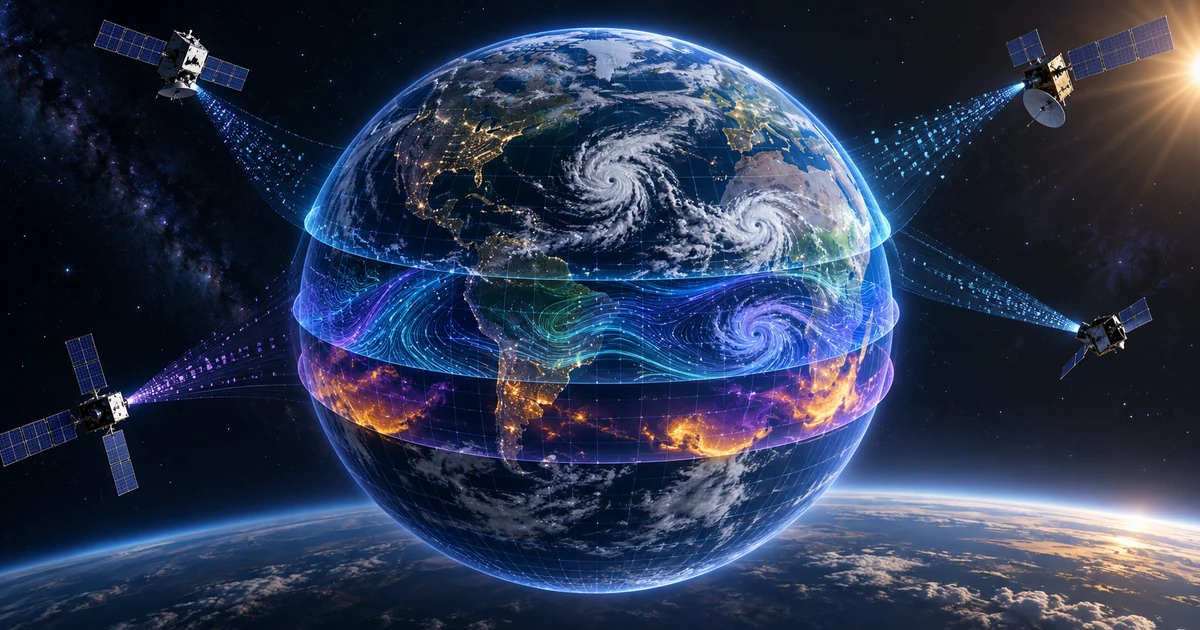
The Google model updates predictions every hour and reaches 5 km grids. Understand uses and limits for energy, logistics, agribusiness and operations.
Direct answer
Google introduced WeatherNext 3 on September 3, 2026 as a global climate prediction model that combines real-time satellite mosaics and historical observations. It generates new forecasts every hour, offers surface variables at up to 5 km resolution and has been integrated with Google products and data. Companies can use the signal for planning, but official alerts and safety decisions continue to depend on the competent meteorological services.
The leap is in updating and detail
Hourly forecasts and finer grids reduce the distance between a global picture and a local decision. This is relevant when rain, wind, heat or cloudiness change routes, shifts, energy generation and team exposure.
Satellite brings the model closer to the current state
WeatherNext 3 learns from observations from geostationary satellites and stations, reducing sole reliance on time-delayed simulations. Gain does not eliminate uncertainty: each variable, horizon and region needs its own validation.
Enterprise applications need rules
An operational product must transform forecast into risk ranges, limits and approved actions. Protocolless integration can only automate inconsistent decisions. Maintain source, time, version and trust with the event.
Useful metric is impact avoided
Evaluate delays, losses, consumption, unavailability and false alarms, comparing the model with the current process. Average accuracy does not show whether the forecast got the critical events that really move the business right.
Nexus Reading
Climate AI gains value when it meets spatial visualization, operational context and scenario simulation. A pilot must begin with a bounded decision, historical data, and explicit human authority.
FAQ
WeatherNext 3 replaces official forecast?
No. Google itself recommends consulting local meteorological services for severe warnings and public safety.
Which companies can benefit?
Energy, logistics, agribusiness, construction, events and external operations have clear cases, as long as there is data and a decision protocol.
What is the first step?
Choose a recurring decision, measure the baseline and test whether the new signal improves in advance without raising false alarms.
Essential guides to delve deeper into the decision
This editorial analysis was produced by Nexus from the official sources below, consulted on September 13, 2026. The text is original and interprets practical implications for companies.
- Google — Introducing WeatherNext 3: release, architecture, resolution, reviews and official availability.
- Google DeepMind — WeatherNext: scientific context and family of AI weather forecasting models.
Date reported by main source: September 3, 2026; analysis published on September 13, 2026.