
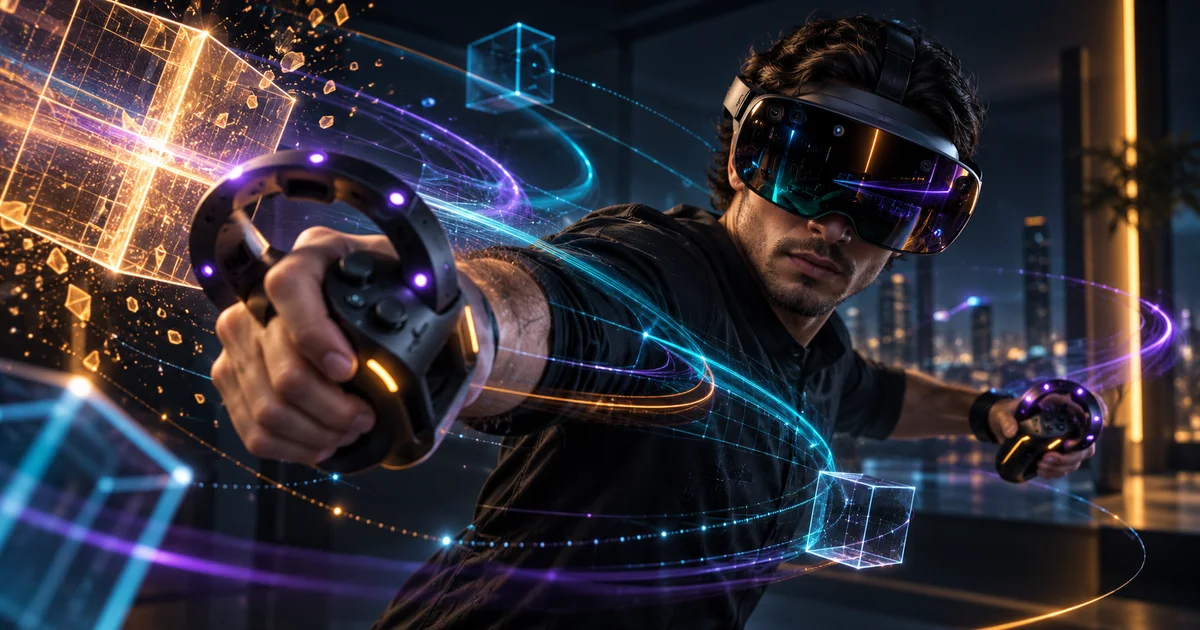
Apple documents controllers with infrared LEDs, IMU, buttons, touchpads, and haptics. Understand applications and requirements for enterprise hardware.
Direct answer
In visionOS 27, Apple describes spatial accessories that combine infrared LEDs and IMU for low-latency 6DoF tracking, as well as physical and haptic inputs. These devices can be tracked at up to 90 Hz and operate in fast motion or low lighting. Openness favors specialized tools, simulators and controls, but requires calibration, ergonomics, security, firmware, tracking recovery and operational support.
Physical input increases accuracy
Buttons, triggers, touchpads and haptics can provide tactile confirmation where gaze and gesture are not enough.
Ninety hertz does not guarantee low total latency
Measure end-to-end sensing, fusion, transport, processing, rendering, and haptic feedback.
Calibration needs to survive operation
Changing environment, occlusion, battery, and physical fixation affect tracking. Create guided diagnosis and recovery.
Hardware brings additional responsibility
Plan hygiene, inventory, charging, firmware, replacement, physical security and support.
Nexus Reading
Spatial accessory must solve a measurable task. Pilot with ergonomics, precision and operational continuity before climbing.
FAQ
What sensors are mentioned?
Apple describes infrared LEDs and IMU, as well as inputs and haptics.
Does tracking work in low light?
Apple claims support for low-light cases, but the actual environment must be tested.
Which business application?
Technical training, simulator operation, design, maintenance and control of virtual tools.
Essential guides to delve deeper into the decision
Esta análise editorial foi produzida pela Nexus a partir das fontes oficiais abaixo, consultadas em 10 de outubro de 2026. O texto é original e interpreta implicações práticas para empresas.
- Apple Developer — WWDC26 visionOS guide: Official specifications of space accessories, frequency and components.
- Apple Developer — Build next-generation experiences with visionOS 27: official session on tracking, engines and use cases.
Date reported by main source: WWDC 2026; analysis published on October 10, 2026.