
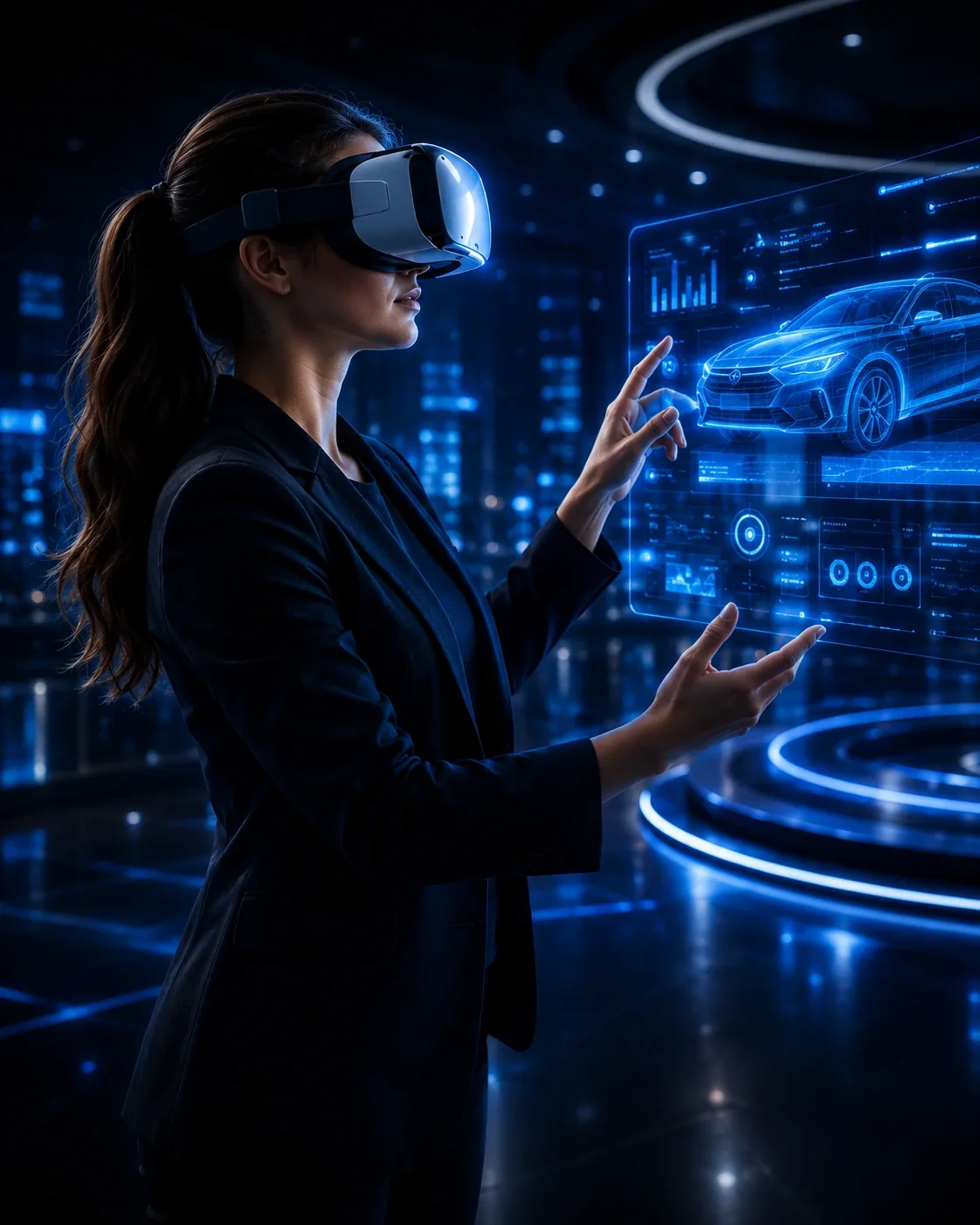

Apple introduced foveated streaming, Spatial Preview, and visionOS 27 advancements. See the impact for 3D viewing and professional VR.
Direct answer
Foveated streaming allows you to render heavy content on a PC or in the cloud and send more quality to the region observed by the user. This opens up space for higher fidelity engineering, simulation, and 3D review, but requires stable networking, security, and latency testing.
What changed in visionOS 27
Apple introduced improvements to RealityKit, Reality Composer Pro, tracking, and immersive media. For professional applications, two points stand out: Spatial Preview, which brings 3D streams closer to Mac and Vision Pro, and Foveated Streaming, capable of connecting experiences to local stations or cloud servers.
How foveated streaming works
The technique focuses rendering quality on the approximate region at which the person looks. Instead of transmitting each pixel with the same level of detail, the system uses the graphics budget where it is perceived. The potential gain is large, but the experience remains sensitive to latency, compression, network stability and rapid gaze changes.
Enterprise use cases
Engineering models, simulators, product reviews, and training environments can use external GPUs without requiring all processing to happen on the device. Spatial Preview also reduces the delay between editing an asset on your Mac and evaluating it at spatial scale, useful for proportion, ergonomics, and layout decisions.
Risks and requirements
The architecture needs to define where content is processed, how the session is authenticated, and whether sensitive data can leave the network. Tests should measure end-to-end latency, visual stability, reconnection time, and comfort across different usage profiles. A beautiful prototype on an ideal network does not prove operational viability.
Nexus Reading
The advance brings spatial computing closer to professional pipelines already used in 3D. The opportunity isn't in porting screens to a headset, but in enabling teams to examine complex content with scale, depth, and collaboration. The experience must be redesigned for the space, not just mirrored.
FAQ
Does foveated streaming reduce quality?
It redistributes quality to prioritize the observed region; perception depends on implementation, networking and tracking.
Do I need an external GPU?
The proposal is precisely to allow local or cloud endpoints for loads that exceed the device's processing capacity.
Which pilot makes sense?
A real scene, with a real network, real users and latency, comfort and task completion metrics.
Essential guides to delve deeper into the decision
This editorial analysis was produced by Nexus from the official sources below, consulted on September 4, 2026. The text is original and interprets practical implications for companies.
- Apple Developer — What’s new in visionOS 27: official guide for RealityKit, Spatial Preview, streaming and tracking.
- Apple Developer — Build next-generation experiences with visionOS 27: official technical session on development paths and Foveated Streaming.
Date reported by main source: WWDC 2026.