

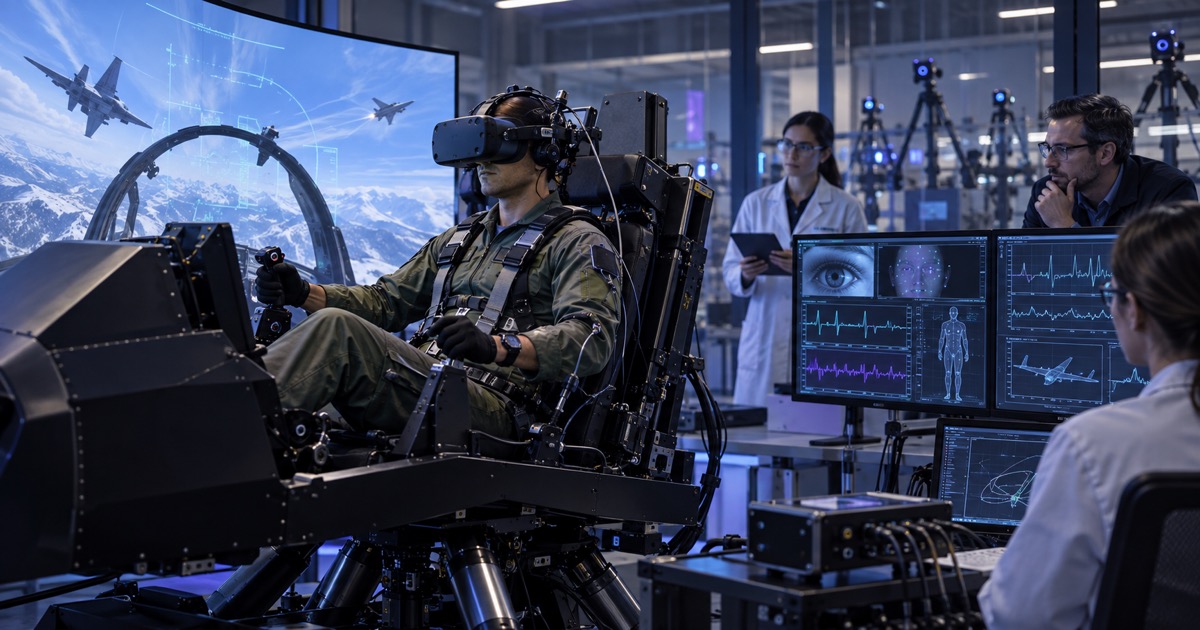
The Strike Fighter League uses standardized rigs and professional XR to measure skills. See lessons applicable to corporate training and assessment.
Direct answer
A VR simulator becomes a measuring instrument when the environment, hardware, rules and criteria remain standardized across participants and sessions. In the case disclosed by Varjo, the Strike Fighter League uses four tests and professional rigs so that the score reflects human performance, not platform variations.
The case presented
Strike Fighter League describes its simulator as a measuring instrument, not just entertainment. Four types of evidence isolate control, precision, perception and visual combat. Competitors use standardized rigs and published criteria.
Standardization protects validity
If two participants see different resolutions, latencies, or fields of view, the result mixes skill and equipment. Hardware, version, calibration, initial conditions, and event logging need to remain controlled for reliable comparisons.
Fidelity must serve competence
The simulator does not reproduce 7G load or real physical risk, a limitation recognized by the source itself. It measures specific components that can be practiced and observed. Corporate training must also declare what is transferred and what is left out of the model.
How to turn training into assessment
Define observable behaviors, tolerances, scenario sequence, and scoring rule before the pilot. Conduct calibration sessions, test repeatability, and compare virtual results to on-the-job performance whenever possible.
Nexus Reading
VR maturity appears when the experience produces evidence, not just presence. A useful simulator connects competency objectives, instrumentation and debriefing, allowing you to learn and decide based on consistent data.
FAQ
Is every VR simulator suitable for evaluation?
No. You need to control the scenario, hardware, rules, metrics and repeatability.
Does high fidelity guarantee validity?
No. Fidelity must match the skills the assessment is intended to measure.
What to register?
Events, errors, time, trajectory, version, calibration and conditions of each session.
Essential guides to delve deeper into the decision
This editorial analysis was produced by Nexus from the official sources below, consulted on September 8, 2026. The text is original and interprets practical implications for companies.
- Varjo — Strike Fighter League: The Sim is the Instrument: official description of the format, proofs, hardware and fidelity criteria.
- Varjo — XR-4 Series: official reference of the headset used in the rigs described.
Date reported by the main source: August 18, 2026.