
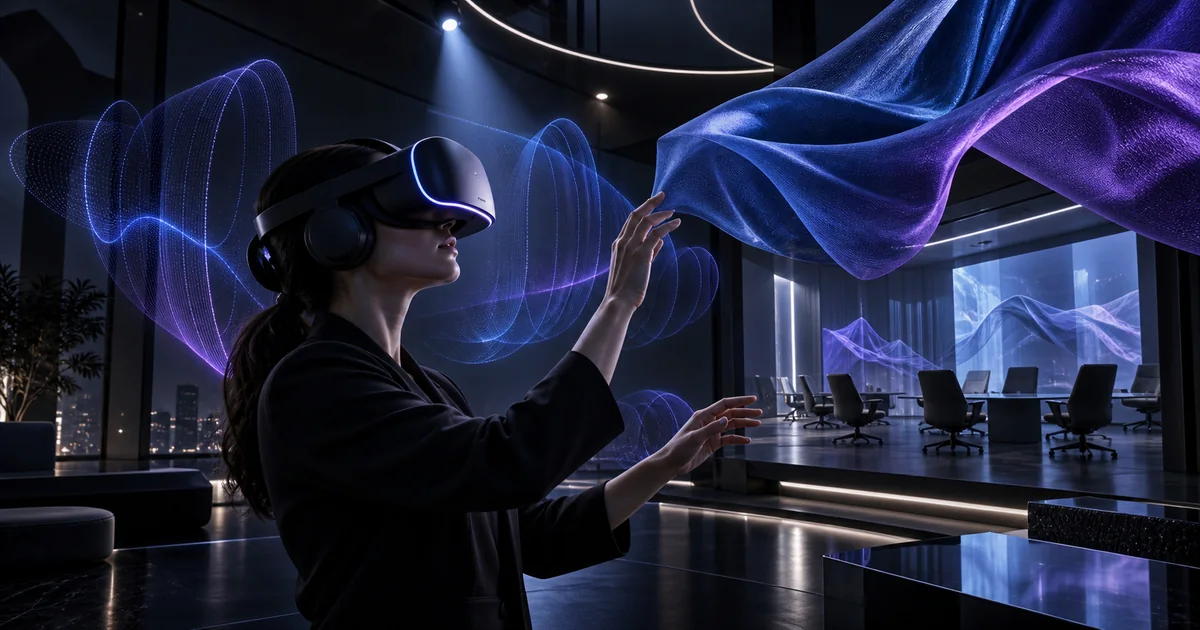
New features in visionOS 27 increase presence and realism in simulations. Understand when they help VR training and how to avoid cost without return.
Direct answer
RealityKit in visionOS 27 adds physical space lighting, projective textures, real-time fabric simulation, and custom reverb meshes. These features can make training and visualization more convincing, but should be used when realism improves a decision, skill, or understanding of the environment.
Realism needs to serve the task
Fabric, light and reverberation influence perception of weight, material, distance and environment. In training, these signals are useful when they help recognize conditions, anticipate consequences, or perform a procedure.
Lighting and projective textures
Physical space lighting allows virtual elements to affect real surfaces, while projective textures simulate light patterns. This can support security, architectural, retail and event demonstrations.
Fabric in real time
Flexible materials react to movement and interaction, opening up space for scenarios with clothing, coverings, barriers and malleable components. Loyalty must be compared to the behavior that really matters for learning.
Spatial audio as an operational variable
The reverb mesh models absorption and dispersion by material. In industrial environments, auditoriums or facilities, acoustic difference can improve orientation and signal recognition, provided it is tested with the target hardware.
Nexus Reading
Realism is not an end. The best investment focuses fidelity on the stimuli that change behavior, decision and retention, while maintaining performance and comfort within the device budget.
FAQ
Does more realism always improve training?
No. It helps when it represents cues relevant to the task and does not compromise performance or comfort.
Should spatial audio be validated on-site?
Yes. Hardware, simulated acoustics and usage conditions affect perception.
How to prioritize resources?
Map out which visual, physical, and audio cues influence each learning objective.
Essential guides to delve deeper into the decision
This editorial analysis was produced by Nexus from the official sources below, consulted on September 10, 2026. The text is original and interprets practical implications for companies.
- Apple — Build next-generation experiences with visionOS 27: official vision of lighting, fabrics, audio and spatial content.
- Apple — Explore advances in RealityKit: technical details of simulation, Gaussian splats and reverb mesh.
Date reported by main source: WWDC 2026.