
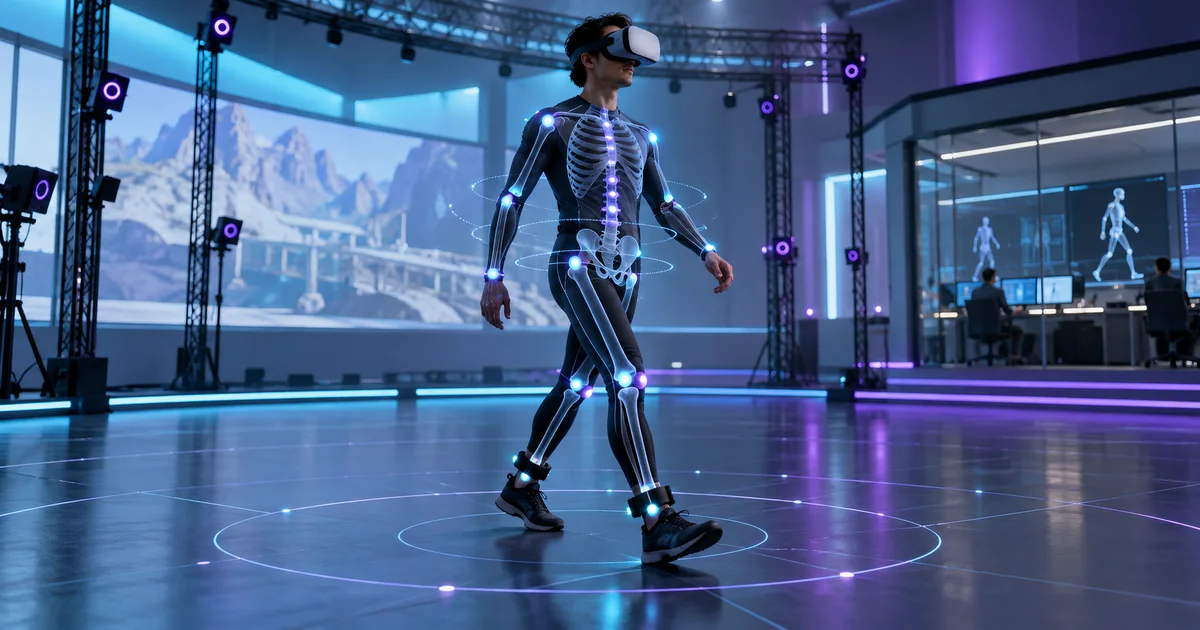
Body tracking uses 14 or 24 joints and relies on calibrated Motion Trackers. See how to design a resilient corporate flow.
Direct answer
PICO documentation describes body tracking with 14 joints in half-body mode and 24 in full-body mode, using PICO Motion Trackers and a calibration step. Applications distributed with the feature must allow pairing and calibration within the experience itself. Because quality may degrade after movement, repositioning, or resuming, the product needs to observe the calibration state and remeasure before using the pose in training or evaluation.
Bigger skeleton doesn't mean more confident pose
More articulations increase expressiveness, but fixation and calibration errors also propagate. The application must use trust and fallback.
Calibration is part of the journey
Forcing the user to exit the app interrupts training. Pairing, visual instruction, and confirmation must exist in the context of the task.
Quality loss needs to be detectable
Distorted avatar cannot be treated as human error. Pause metrics, flag degradation, and offer guided recalibration.
Resumption deserves specific regression
Putting on and taking off the headset, suspending the app or moving trackers can change the state. Testing must cover each transition and recovery.
Nexus Reading
Corporate body tracking is a measurement system. Record hardware, calibration, confidence, and exceptions before turning movement into a note or decision.
FAQ
How many joints are tracked?
The documentation states 14 in half-body mode and 24 in full-body mode.
Does the application need to include calibration?
For distribution with the feature, the PICO checklist requires support for pairing and calibration within the app.
Can pose feed automatic evaluation?
Only with trust criteria, human validation and treatment of tracking loss proportional to the risk.
Essential guides to delve deeper into the decision
This editorial analysis was produced by Nexus from the official sources below, consulted on October 24, 2026. The text is original and interprets practical implications for companies.
- PICO Developer — Body Tracking: joints, trackers, calibration, states and life cycle.
- PICO Developer — PICO XR Check: Pairing, calibration, and testing requirements for distributed applications.
Date reported by main source: official documentation consulted on October 24, 2026; technical analysis.