

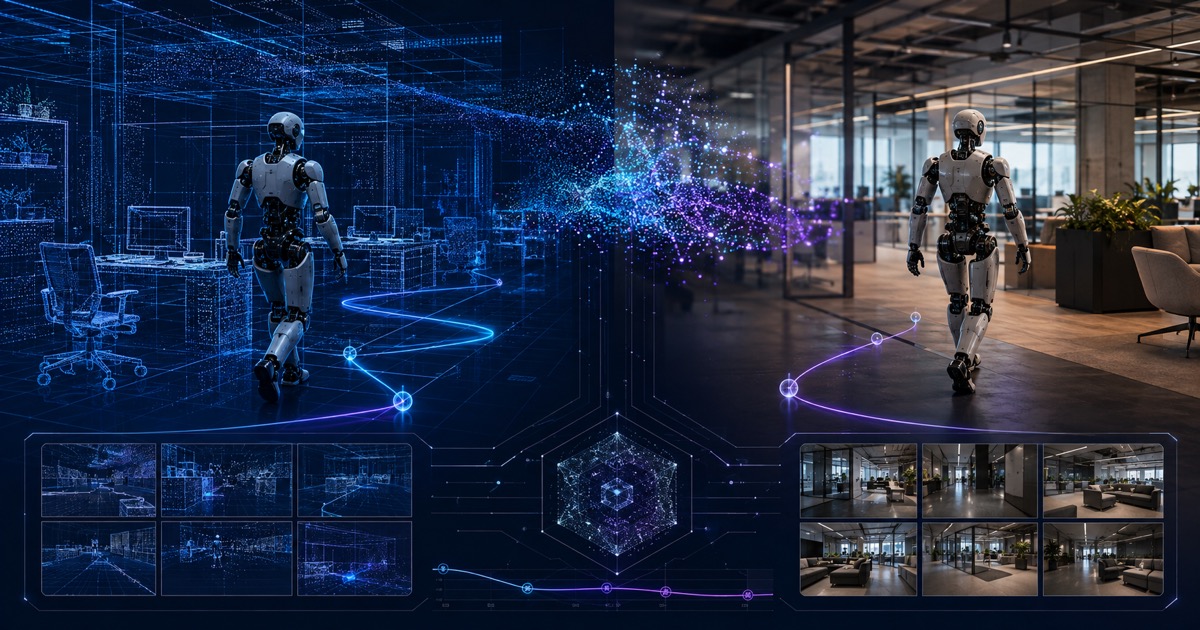
The pipeline reconstructs real locations to train visual policies in simulation and transfer them to humanoids. See implications for XR and physical AI.
Direct answer
Niantic Spatial and Flexion demonstrated a pipeline that captures a location with an RGB camera, creates a photorealistic digital twin, and trains navigation on NVIDIA Isaac Sim and Isaac Lab. The visual policy was transferred to the real robot without additional on-site training, according to the joint report.
The pipeline demonstrated
A location is captured with regular or 360-degree camera video and reconstructed as a visual environment and collision mesh. The scenario goes into Isaac Sim and Isaac Lab, where multiple robot instances learn navigation in parallel before running in physical space.
Why RGB adds to the challenge
Depth describes form, while RGB images carry texture, lighting and meaning. Small differences between simulation and reality can confuse policy. Reconstructing the real location approximates training observations from the camera used on the robot.
Where XR and robotics converge
The same spatial assets that support immersive training and digital twins now serve physical agents. Capturing, coordinates, semantics and updating the environment become common infrastructure for people, XR systems and robots.
How to evaluate a company
Start with supervised navigation in a controlled area. Measure collisions, route success, sensitivity to change, and the difference between simulation and operation. Failure scenarios should include people, moved objects, and different lighting than the capture.
Nexus Reading
The digital twin stops being just a visualization and becomes a training ground. Companies that maintain up-to-date spatial representations will be able to reuse the same investment in human simulation, planning and physical automation.
FAQ
Does the robot learn directly in the real world?
In the case described, the policy was trained in simulation and transferred to the physical environment.
Is a regular camera enough?
The publication reports capture with RGB, including 360 video, but quality depends on the location and pipeline.
Does the digital twin need to be updated?
Yes. Physical changes can reduce policy fidelity and performance.
Essential guides to delve deeper into the decision
This editorial analysis was produced by Nexus from the official sources below, consulted on September 7, 2026. The text is original and interprets practical implications for companies.
- Niantic Spatial and Flexion — Closing the Sim2Real Gap for Humanoids: pipeline, capture, RGB training and disseminated transfer.
- NVIDIA — Isaac Yes: official reference of the robotic simulation platform.
Date reported by the main source: July 20, 2026.