
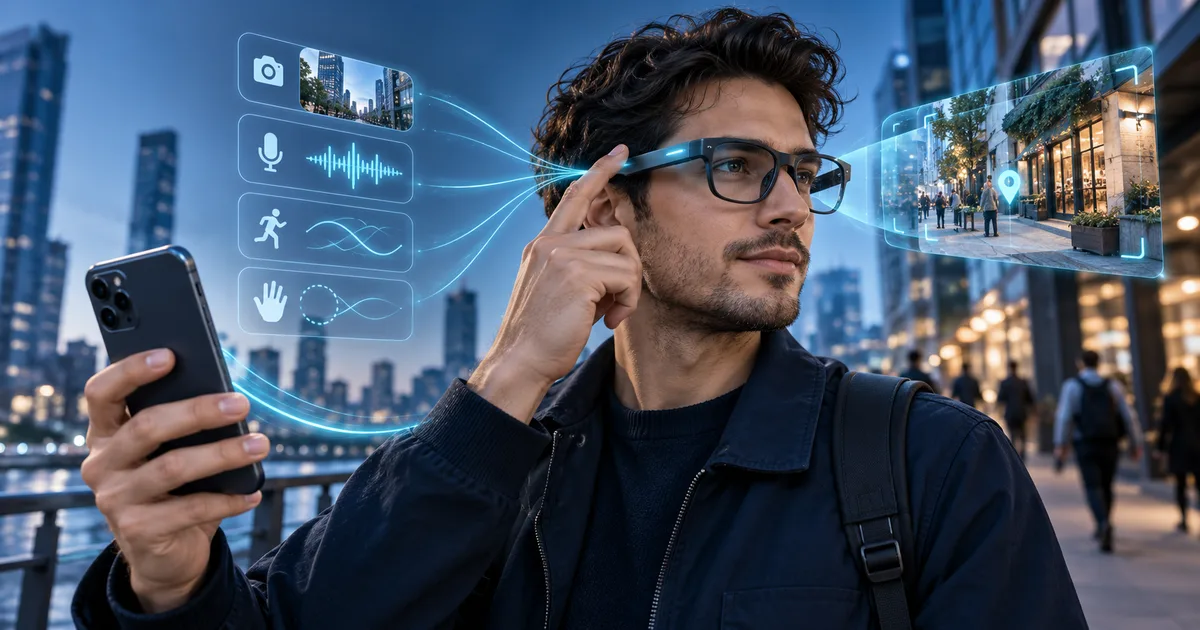
Version 1.0 connects camera, voice, motion and gestures to mobile apps. See device limits, consent, and real-world testing.
Direct answer
Meta reported that the Wearables Device Access Toolkit 1.0 began shipping on September 30, 2026 after a year in preview. The integration maintains logic and backend in the mobile application and uses the glasses as a hands-free interface, with camera, voice, movement and, depending on the device, display and Neural Band. Availability and capabilities vary by market and model, so product, consent, and fallback must be designed by detected capability.
Stable does not mean uniform
A supported API can provide different features on display and non-display glasses.
Cell phones remain at the center
Existing logic and backend reduce migration, but connectivity and state between devices need handling.
Camera and voice require consent
Signaling, minimization and retention must consider the user and people around them.
Movement improves context
Head orientation can enrich assistance, as long as error and low confidence have fallback.
Nexus Reading
Create a capabilities matrix, test outages, and only publish clear flows about collection and control.
FAQ
Is Toolkit 1.0 still a preview?
No. Meta describes it as a stable and supported version.
Does it work in all countries?
The SDK is widely downloadable, but full capabilities depend on supported markets.
Do all glasses have the same features?
No. Display, gestures and other capabilities vary by model.
Essential guides to delve deeper into the decision
This editorial analysis was produced by Nexus from the official sources below, consulted on October 5, 2026. The text is original and interprets practical implications for companies.
- Meta — AI glasses developer recap: 1.0 release, capabilities, development and distribution paths.
- Meta — Wearables FAQ: official status, markets, devices and requirements.
Date reported by the main source: September 30, 2026.