
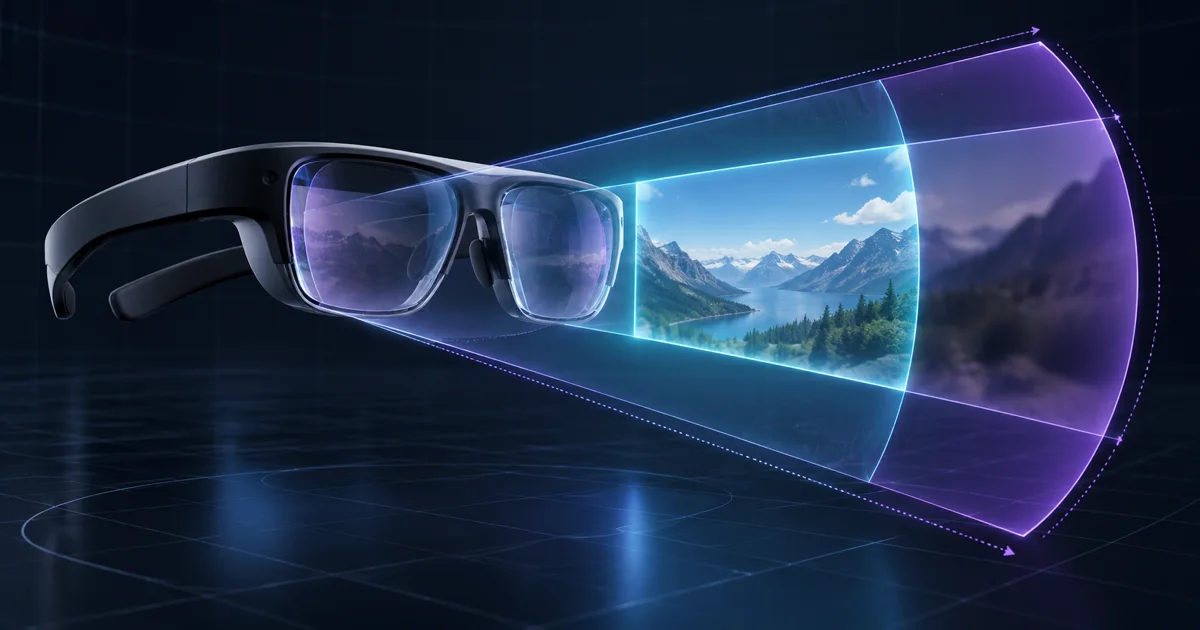
Meta publishes field of view, rendering, and resolution values per eye. See why pixels don't define the safe area of the VR interface.
Direct answer
Meta published on September 25, 2026 that the Meta VR Glasses have a nominal field of view of 70 degrees horizontally by 66 degrees vertically, a rendering extent per eye of 74 degrees by 68 degrees, and a physical panel of 2412 by 2288 pixels per eye. These numbers describe different things: resolution is not the visible limit, and the nominal field is just a ceiling, because fit, distance from the eyes, and direction of gaze can reduce the perceived area. Interfaces must keep critical actions close to the center, use angular size, and be tested with simulation and real hardware.
Three measures are not interchangeable
Visible field, rendered projection, and pixel grid serve different purposes. Using resolution to position UI leads to weak decisions.
Fitting changes what a person sees
Eye-to-lens distance and position on the face especially reduce vertical visibility. The layout needs to tolerate real human variation.
Looking around the edges loses accuracy
Peripheral targets appear smaller and may require head movement. Primary actions, alerts and status should be in a comfortable central region.
Simulation finds early cuts
The Meta VR CLI can apply rough cropping on compatible Quest, but the documentation itself points out that this does not reproduce the view through the lens.
Nexus Reading
Define zones by angle, not by pixel; test on both eyes, with different fittings and postures, and offer alternative paths for any action placed on the periphery.
FAQ
What is the nominal field of view?
The Goal reports 70 horizontal degrees by 66 vertical degrees looking ahead.
Does the panel resolution define the interface size?
No. Resolution describes the physical grid of pixels, not the visible area or apparent size of the content.
Does simulation replace physical testing?
No. It anticipates cuts, but the final acceptance needs to consider lens, fit, comfort and actual hardware.
Essential guides to delve deeper into the decision
This editorial analysis was produced by Nexus from the official sources below, consulted on September 30, 2026. The text is original and interprets practical implications for companies.
- Meta — VR Glasses field of view and display values: field of view, rendering extent, resolution, and test orientation.
- Meta — Test your app for Meta VR Glasses: test matrix on simulator, Quest and final hardware.
Date reported by main source: September 25, 2026; technical analysis.