
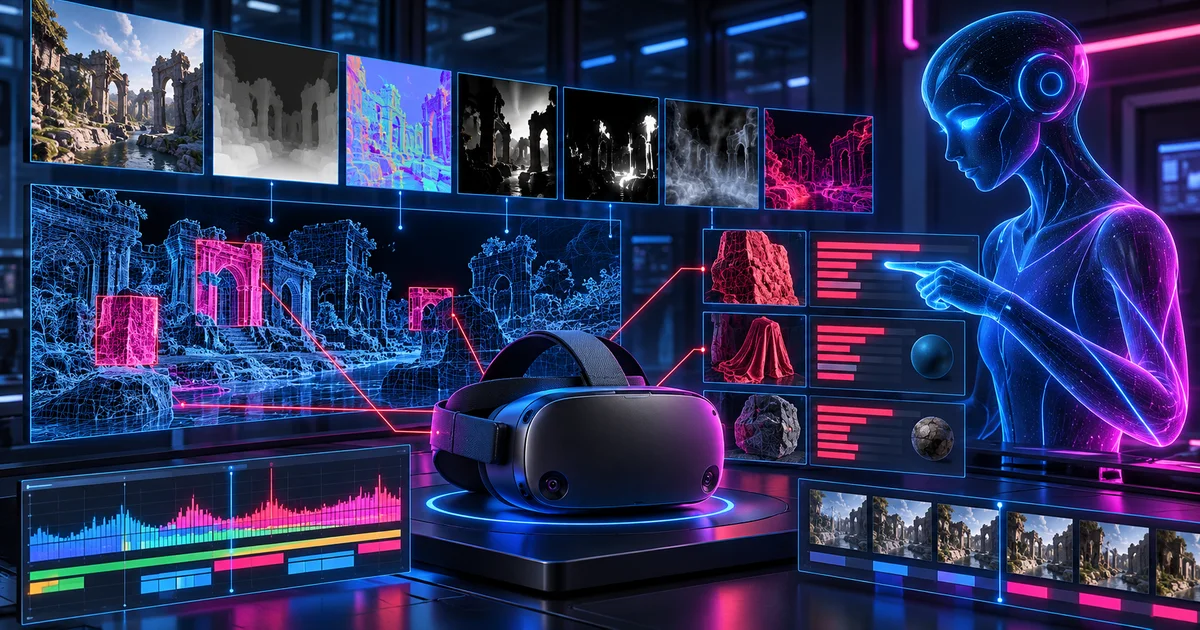
RenderDoc wrappers and Meta VR CLI promise to turn frame captures into assisted investigation. See what to automate and how to avoid blind optimizations.
Direct answer
Meta claims that its agentic flows for Unity combine Meta VR CLI and AI-driven RenderDoc wrappers to reduce hours of manual trace analysis. The agent can help locate passes, shaders, and costly objects, but an isolated capture does not represent the entire session. Reliable diagnostics requires reproducing scene, device, temperature, motion, resolution, and build version, as well as confirming any optimizations in before and after metrics.
Frame capture shows local cause
The capture helps explain GPU, draw calls, resources and states in that frame. CPU, network, physical and thermal ask for other evidence.
Agent speeds up screening, not true
Suggestions need to point to measurable evidence and consider visual quality, memory and compatibility.
Reproducible scenario is mandatory
Use the same trajectory, device, configuration, thermal state, and content to compare versions.
Optimization can shift the bottleneck
Lowering GPU may increase CPU, memory or artifacts. Measure full system and long sessions.
Nexus Reading
Automate initial trace reading and preserve a human gate: hypothesis, minimum change, comparison and rollback.
FAQ
Does RenderDoc measure the entire app's performance?
No. It deepens the rendering; other tools cover CPU, memory, thermal, and networking.
Can AI apply correction automatically?
You can propose changes, but they need review, build and comparable testing.
What evidence to keep?
Capture, version, setup, scene, before and after metrics, and visual impact.
Essential guides to delve deeper into the decision
Esta análise editorial foi produzida pela Nexus a partir das fontes oficiais abaixo, consultadas em 10 de outubro de 2026. O texto é original e interpreta implicações práticas para empresas.
- Goal — Accelerating Your Unity VR Workflow: Official reference to Meta VR CLI and AI-assisted RenderDoc wrappers.
- RenderDoc — Official documentation: primary documentation of the graphical capture and analysis tool.
Date reported by main source: June 10, 2026; analysis published on October 10, 2026.