
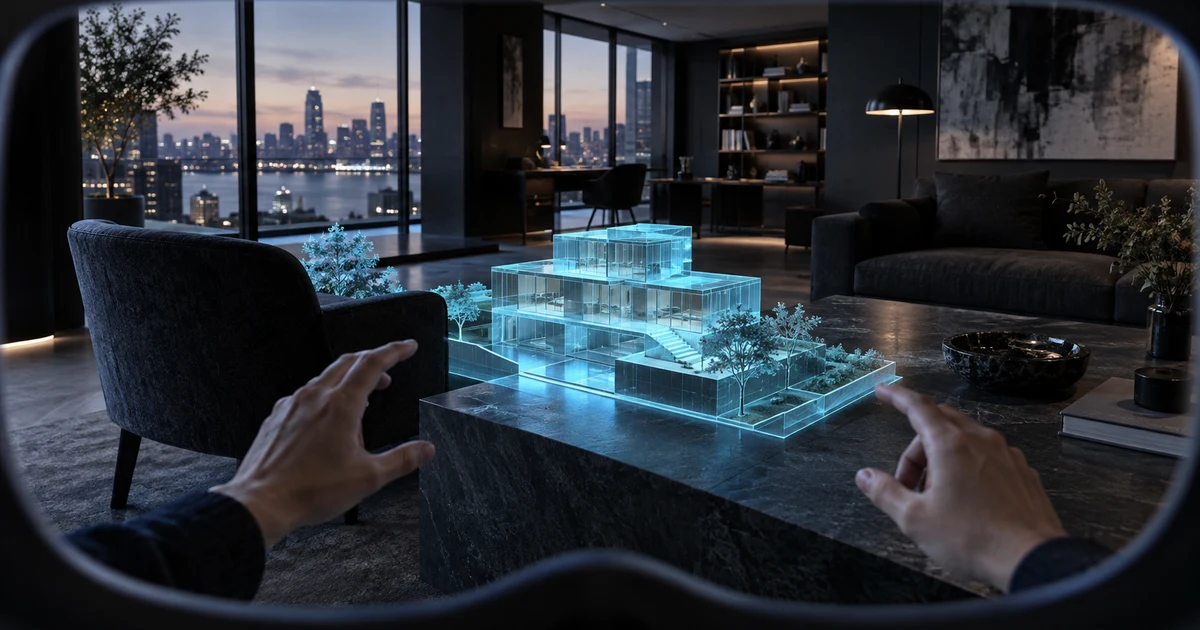
Stereo, color and depth cameras connect digital objects to real space. Understand security, occlusion, and experience design.
Direct answer
Horizon OS passthrough uses stereo cameras to display the physical environment inside the headset and form the basis of mixed reality experiences. In Quest 3 and 3S, the visualization is in color and can be combined with depth estimation and occlusion. The technology improves spatial awareness and integration between real and digital, but should not be treated as perfect human vision: latency, camera quality, lighting and depth limits require safe design and on-site testing.
Passthrough maintains space reference
Seeing walls, people and objects can reduce isolation and facilitate onboarding. The experiment must still define safe limits and not depend on small details in the image.
Depth sustains convincing occlusion
Spatial estimates allow virtual objects to appear to pass behind real elements. Mesh or update errors break the illusion and can confuse the interaction.
Lighting changes the quality
Dark environments, backlighting and uniform surfaces reduce visual information. Tests must cover actual operating conditions and provide instructions or fallback.
Privacy needs to be on the roadmap
Ambient-facing cameras can capture people, screens, and sensitive spaces. The application must minimize data, explain permissions, and avoid unnecessary retention.
Nexus Reading
Passthrough generates value when the physical world participates in the task, not just in the background. Spatial planning, occlusion, contrast and security must be created together in the prototype.
FAQ
Is Passthrough augmented reality?
It is a mixed reality base on headsets: the user sees the environment through cameras with composite digital content.
Does imaging replace direct vision for critical tasks?
No. Quality, latency and perception may vary; Risky tasks require their own controls and unobstructed vision when necessary.
What to test first?
Lighting, space limits, interface reading, occlusion, comfort and behavior when mapping loses quality.
Essential guides to delve deeper into the decision
This editorial analysis was produced by Nexus from the official sources below, consulted on September 17, 2026. The text is original and interprets practical implications for companies.
- Meta Horizon OS Developers — Passthrough: official view of passthrough, stereo cameras, color, depth, and mixed reality composition.
- Meta Horizon OS Developers — Performance optimization: Official performance and validation guidelines for applications in the Quest ecosystem.
Date reported by main source: documentation updated on September 15, 2026.