
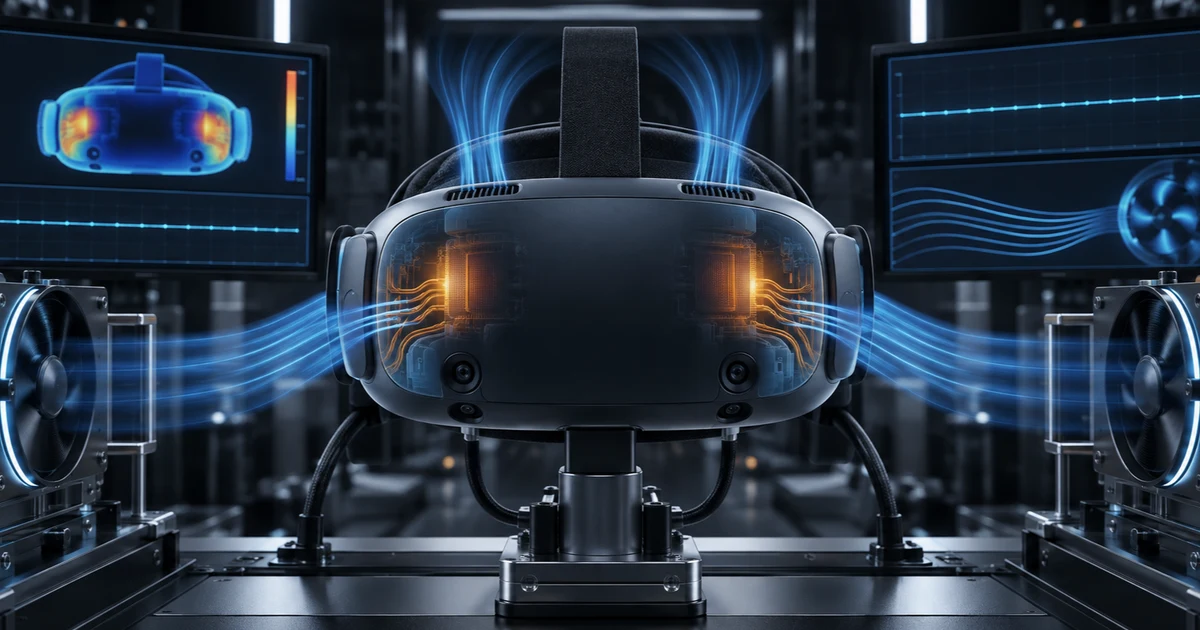
Horizon OS reduces clocks when heat exceeds the sustainable budget. See how to avoid frame drops and degradation in long sessions.
Direct answer
The Meta Quest thermal management documentation, updated September 15, 2026, explains that Horizon OS monitors SoC, battery, and surface sensors and reduces performance when load exceeds the thermal envelope. The application may have a lower frame rate, longer loading times and even a forced cooling state. Therefore, validating just the first few minutes is insufficient: corporate experiences must measure frame time, temperature and quality during the actual duration of the session.
Fast spike does not represent real session
A scene may meet target frames at first and degrade as the device heats up. The testing protocol needs to last as long as the anticipated training, demonstration, or service.
Headroom is a reliability requirement
Operating permanently at the limit leaves little room for transitions, physics, or load spikes. A sustainable budget reduces variance and protects comfort.
Throttling changes the cost of each frame
When reducing clocks, the same load starts to consume more time. CPU and GPU metrics should be tracked across temperature, not just in an isolated capture.
Quality can adapt with priority
Resolution, shadows, effects, and density can all fall within defined levels, preserving interaction, readability, and latency. Degradation must be gradual and tested.
Nexus Reading
Enterprise VR performance is a property of the entire session. Acceptance criteria should include stability after heating, low battery and environmental conditions close to operation.
FAQ
Why does the application lose performance after a few minutes?
The system can reduce clocks to keep SoC, battery and surface within thermal limits.
FrameSync eliminates the thermal problem?
No. It helps manage frame timing variations, but does not create processing power or remove heat.
How long should the test last?
At least the duration of the actual session, including warm-up, transitions and the busiest sections.
Essential guides to delve deeper into the decision
This editorial analysis was produced by Nexus from the official sources below, consulted on September 18, 2026. The text is original and interprets practical implications for companies.
- Meta Horizon OS Developers — Thermal management: thermal envelope, control stages, throttling, FrameSync and recommendations for sustained sessions.
- Meta Horizon OS Developers — Performance and hardware: Official view of Meta VR devices' CPU and GPU levels, memory, battery, and hardware limits.
Date reported by main source: documentation updated on September 15, 2026.