
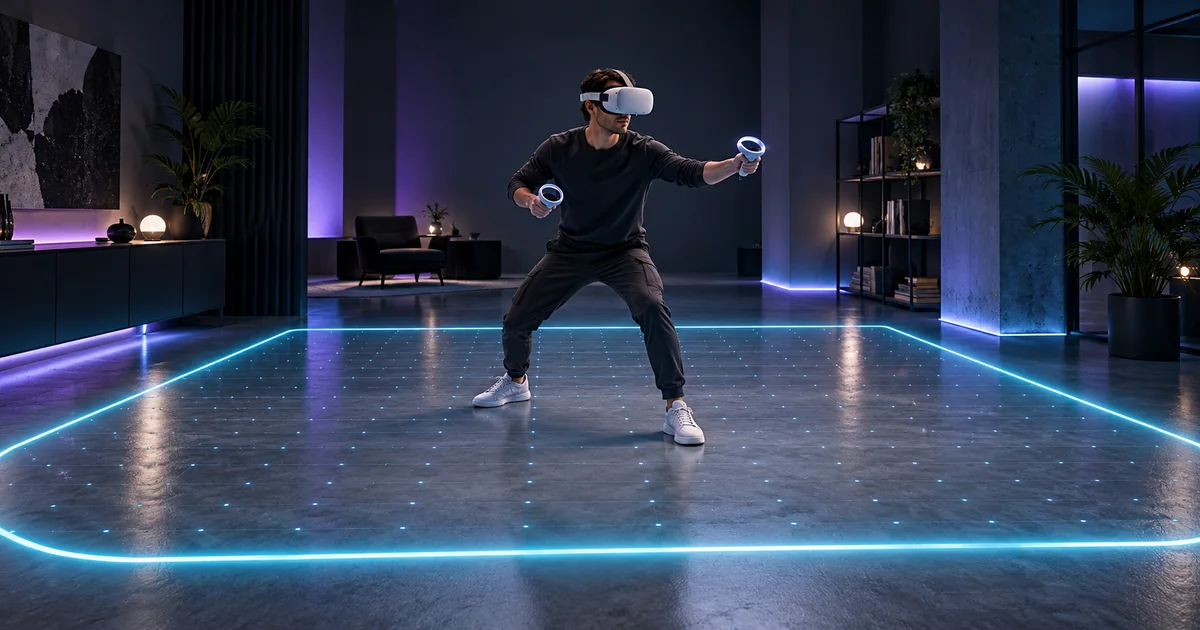
Play area, tracking origin and session resumption need to be included in the VR training design. See operational limits and validations.
Direct answer
Meta Quest's Boundary system uses the user-configured perimeter to calculate a rectangular play area and display alerts when head or controls approach the boundary. Current documentation recommends 9-by-9-foot space for a 6-by-6-foot free playable area in roomscale experiences. Enterprise applications must query dimensions, keep critical content within the area and revalidate limits when returning from pause.
Available area changes ergonomics
Reachable objects, displacement and posture need to fit in the real space, including for users with different heights and mobility.
Tracking origin defines stability
Floor Level and Eye Level respond to recentr; Stage has distinct behavior and is not recommended as a default in the current guidance.
Resumption requires new reading
The limit may change between areas or after pause. Recalculate dimensions before replacing content near edges.
Old API should not guide new projects
Deprecated methods in the OpenXR backend remain legacy, but do not receive evolution and may produce warnings.
Nexus Reading
Include gap testing, resumption, recentr, and edge intrusion into the security checklist of every VR training.
FAQ
Is Boundary just a visual grid?
No. It is a security system and a source of geometry and dimensions of the configured area.
How much space does Roomscale require?
Meta recommends 9 by 9 feet for a 6 by 6 foot unobstructed playable area.
When to check the limits again?
When starting, after resumption and whenever there is a change of area or tracking origin.
Essential guides to delve deeper into the decision
This editorial analysis was produced by Nexus from the official sources below, consulted on October 31, 2026. The text is original and interprets practical implications for companies.
- Meta Horizon OS Developers — Integrate Boundary: play area, roomscale, tracking origin, geometry and deprecated API warnings.
- Meta Horizon OS Developers — Configure camera settings: Eye Level, Floor Level and Stage origins, plus current recommendations.
Date reported by main source: documentation updated on September 10, 2026; analysis published on October 31, 2026.