

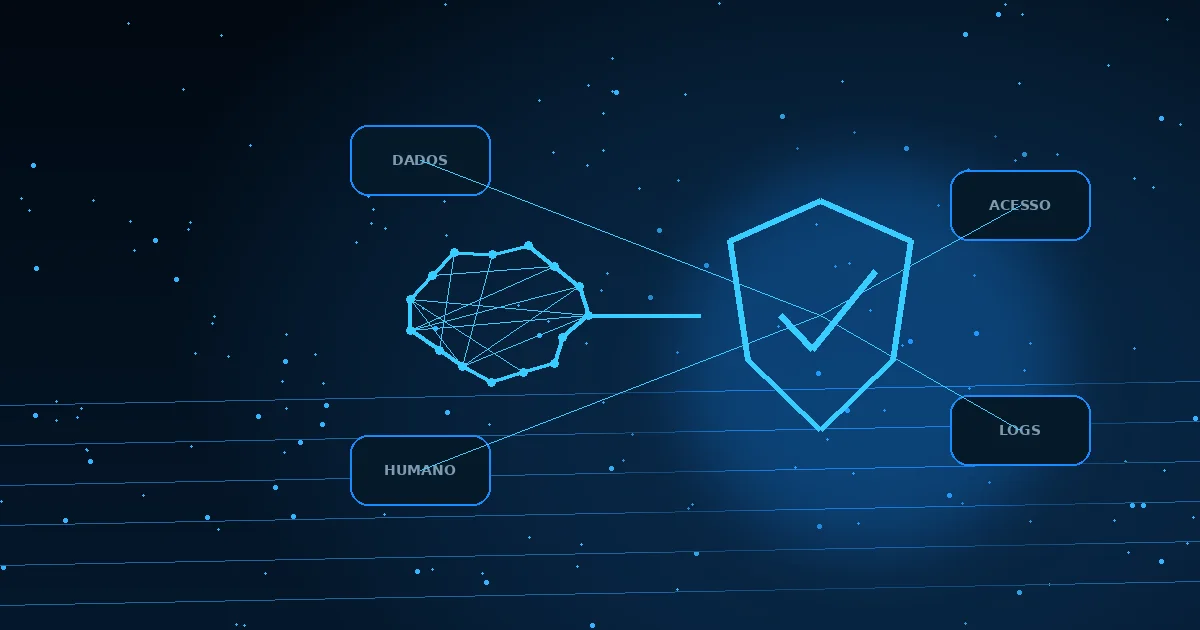
A practical framework for defining sources, access, traceability, human review, and automation limits. The objective of this content is to answer the question in a useful way for anyone who needs to decide, specify or contract a project — without treating technology as an end in itself.
Direct answer
A practical framework for defining sources, access, traceability, human review, and automation limits. In decision terms, the principle is simple: treat governance as part of the product architecture, not as a later review. The central point of this theme is to treat governance as part of the product architecture, not as an afterthought. The technological choice comes later: first the decision, behavior or task that needs to be improved is defined; then the experience and architecture capable of sustaining this result in real conditions of use are designed.
What needs to be understood before technology
In corporate projects, the most productive question is rarely “which technology should we use?”. The correct question is what situation we want to change, who participates in it and why the current flow does not deliver the expected result. From there, it is possible to assess whether immersion, spatial context, 3D visualization, data or automation really change the quality of the experience.
This reasoning avoids two extremes: choosing a sophisticated technology for a simple problem or oversimplifying a case that depends on interaction, scale, context or integration. Treat governance as part of the product architecture, not as an afterthought it is the criterion that organizes the rest of the architecture.
Where this theme tends to generate value
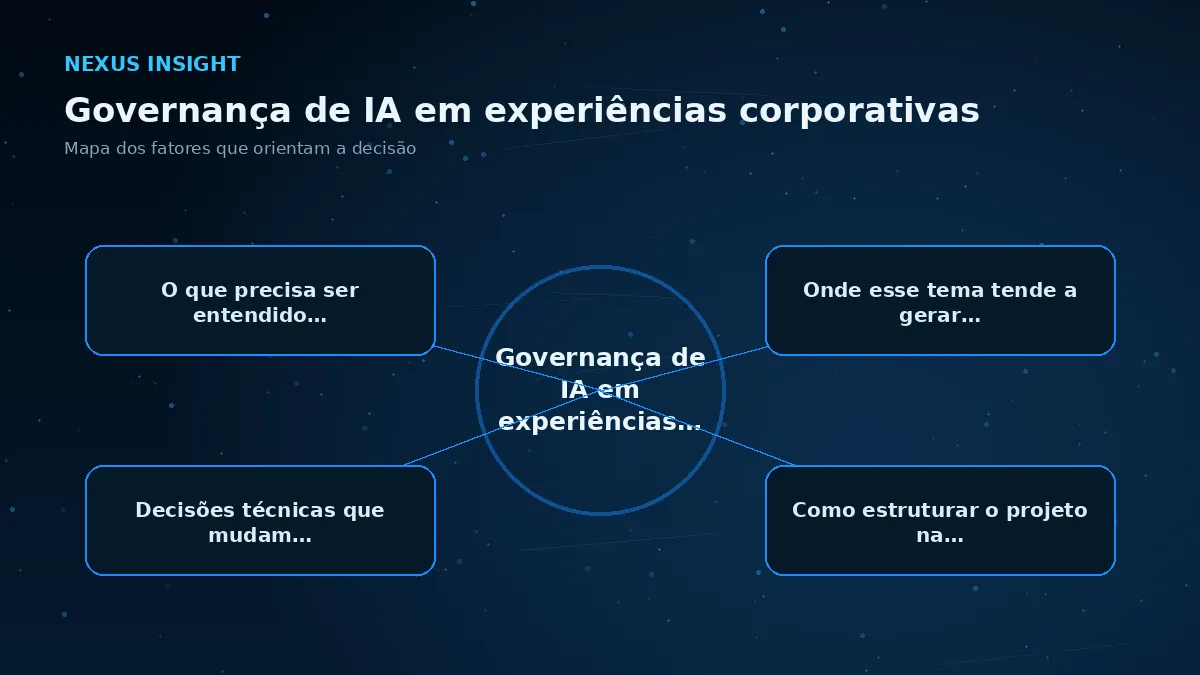
Value appears when technology reduces uncertainty, increases practice, facilitates understanding, speeds up a decision, or makes available something that would be expensive, dangerous, or difficult to physically reproduce. In sales, this may mean explaining a product better; in training, practice a decision; in operations, putting information in context; in 3D, transform an asset into a reusable interface.
The use case must be described as an observable change. Instead of “creating an innovative experience”, prefer formulations such as “reduce the time needed to demonstrate all versions”, “allow hands-on practice without disrupting the real machine” or “give the customer a reliable scale reference before purchase”.
Technical decisions that change the outcome
Data and context
AI models need to be given enough context to solve the task, but they should not have unrestricted access. Sources, permissions, retention, and update need to be defined as part of the architecture.
Tools and actions
Agents can query systems or perform tasks, but each tool increases the risk surface. Critical actions require validation, an audit trail and, in many cases, human review.
Continuous assessment
Quality is not just measured by a demonstration that works. You need to create assessment sets, observe real failures, and adjust instructions, data, tools, and limits throughout the lifecycle.
How to structure the project in practice
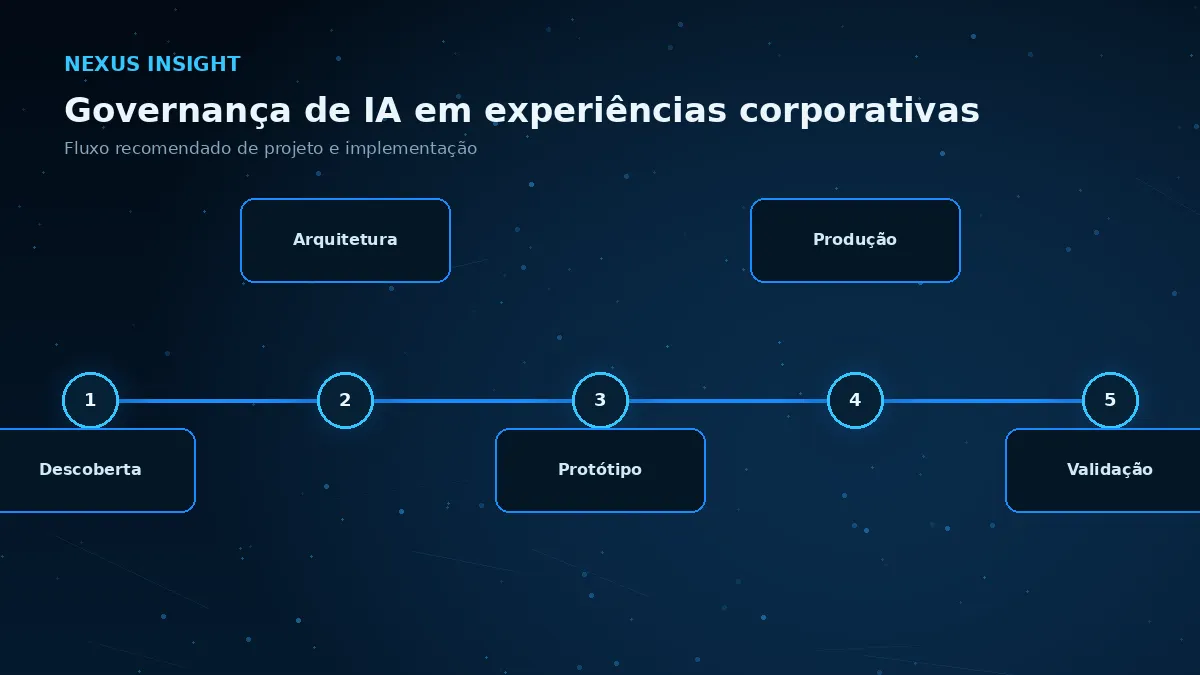
A robust flow starts with discovery and experience design. Then, the team prepares content, data and assets, builds a prototype that tests the biggest risks, validates it with real users and only then consolidates the architecture for deployment. This sequence reduces the cost of discovering late that an interaction, device, or integration does not work in the operating context.
- Discovery: objective, audience, environment, restrictions, baseline and success criteria.
- Architecture: platform, data, content, hardware, integrations and update model.
- Prototype: test the most uncertain part with the lowest possible production volume.
- Production: Develop expertise, assets, and integrations with reusable standards.
- Validation: measure usability, performance, content and results with representative users.
- Deployment and evolution: distribution, support, analytics, updates and governance.
Decision framework
The table below helps convert an idea into a specification. If a line still doesn't have an answer, the project is probably still in the discovery phase.
| Problem | What decision, task or stage of the journey needs improvement? |
|---|---|
| User | Who uses it, in what environment, with what frequency and level of familiarity? |
| Content | What assets, data, 3D models, procedures or rules need to be available? |
| Technology | Which architecture delivers the requirement with the least friction and operational complexity? |
| Metric | How will we know if the solution performs better than the current scenario? |
| Scale | How to update, support, distribute and govern the solution after the pilot? |
How to measure if it worked
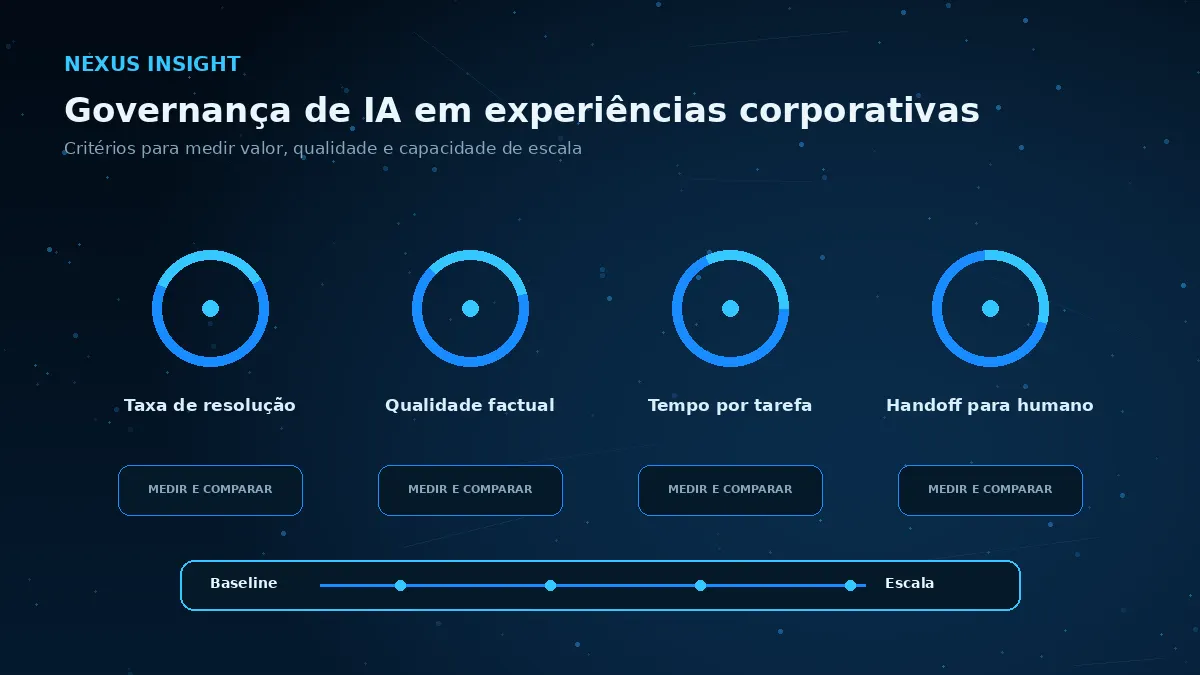
Avoid choosing metrics just because they are easy to collect. Views, clicks, or session time can help you understand usage, but they need to be connected to a business, learning, or operational outcome. For this topic, some possible signs are:
- Resolution rate: define how it will be collected, how frequently and which comparison represents improvement.
- Factual quality: define how it will be collected, how frequently and which comparison represents improvement.
- Time per task: define how it will be collected, how frequently and which comparison represents improvement.
- Handoff to human: define how it will be collected, how frequently and which comparison represents improvement.
- Failures by type and severity: define how it will be collected, how frequently and which comparison represents improvement.
When possible, compare with the current process or a reference group. Improvement needs to be interpreted along with quality, cost and adoption; Gaining speed while increasing error, for example, does not necessarily represent success.
Common mistakes that reduce project value
- Give too broad access to data and actions.
- Do not create representative test cases.
- Use a single prompt as a governance strategy.
- Not monitoring behavior changes after updates.
Most of these errors are not caused by a lack of technology, but by decisions made out of order. The sooner the team tests flow, content, environment and operations, the less likely they are to spend effort refining the wrong part.
What changes when the solution needs to scale
Scale introduces requirements that barely appear in a demo: content updating, version management, devices, connectivity, observability, security, support, operator training, and governance. A solution that works perfectly in one meeting may fail when it needs to operate across dozens of units without the development team present.
Therefore, pilot design must consider the future. This doesn't mean building the entire infrastructure from day one, but rather avoiding choices that prevent upgrade, integration, or distribution when the use case proves value.
FAQ
How do you know if AI governance in corporate experiences makes sense for the company?
Start with the problem and the indicator. If the solution improves a decision, a task, a purchasing experience or a training step that currently has cost, risk, friction or low understanding, there is a concrete hypothesis to test. Treat governance as part of the product architecture, not as an afterthought.
What should be the first step?
Map audience, environment, current journey, restrictions and an indicator of success. This diagnosis reduces rework because it defines what needs to be prototyped, what data or assets are needed and how the result will be compared to the current scenario.
Is it better to start with a pilot?
In most projects with technical or operational uncertainty, a well-designed pilot is useful. It should test the highest-risk parts and end with objective criteria for scaling, adjusting, or stopping the initiative.
How to prevent the project from becoming just a demonstration?
Connect the experience to a real process, define those responsible for operations and updates, and instrument the events that represent value. A demo proves that the technology works; a product proves that someone can use it repeatedly to achieve a result.
This guide was structured based on Nexus' design experience and widely adopted principles in real-time application development. For implementation decisions, validate requirements with the official documentation of the chosen platform, engine or standard.