
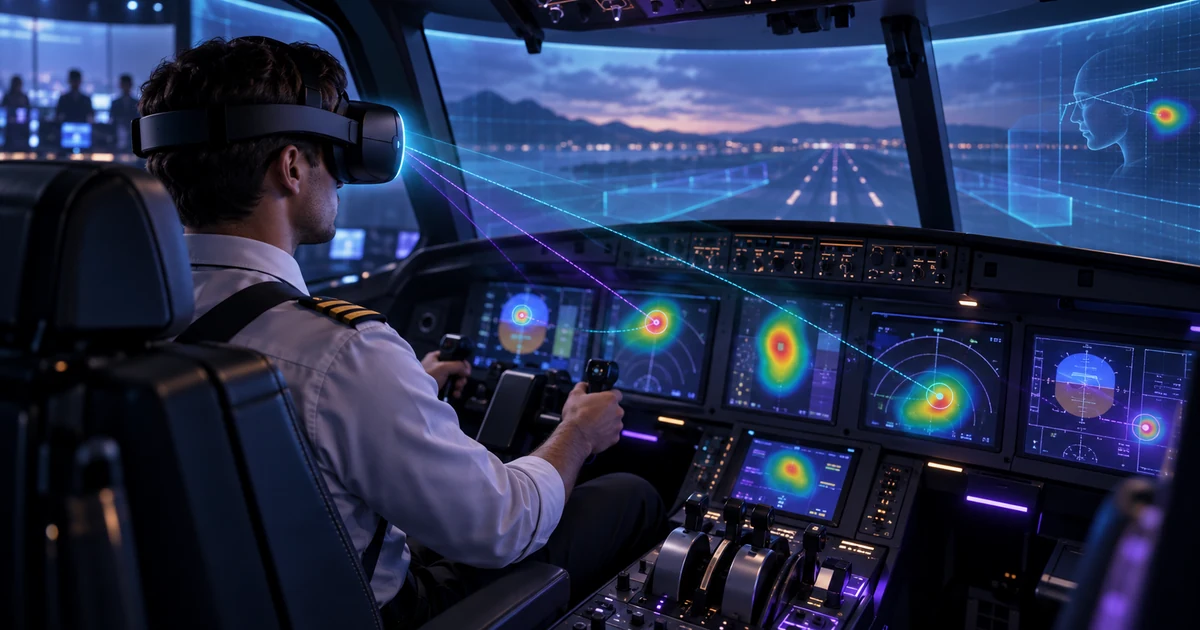
A test with RAF pilots looked at visual scanning, priority and workload. See the potential and limits for corporate assessment.
Direct answer
On September 10, 2026, Varjo published a test of the TACET-M system with RAF trainee pilots. Eye tracking, movement and psychophysiological data were used with AI to analyze patterns related to attention, prioritization and workload. The approach can enrich high-risk training, but the signs should not be treated as a direct diagnosis or replace the instructor.
Attention leaves observable traces
Fixations, visual coverage, query sequence, and return to critical areas can show how a person distributes attention. Interpretation needs to consider the task, the student's experience and what was happening at that moment.
Cognitive load is not a single number
Pupil, heart rate and gauze vary by lighting, fatigue, anxiety and individual characteristics. Models should combine signals, context, and performance rather than converting an isolated measure into a conclusion about stress.
The instructor remains on the circuit
The case itself states that the results help to reveal behaviors that are difficult to observe, but only make sense when interpreted by someone who knows the scenario and the expected pattern.
Applications outside of aviation
Machine operation, control center, maintenance and emergency response also require visual search and prioritization. A pilot should start with few observable skills and clear intervention criteria.
Nexus Reading
Immersive training matures when it moves from presence and completion to evidence of decision. Technology must explain where to support the student, without transforming correlation into automatic judgment.
FAQ
Does eye tracking measure attention directly?
It records eye behavior; attention needs to be inferred with context, task, and other evidence.
Does AI replace the evaluator?
No. It can organize signals and suggest patterns, while the evaluator validates meaning and consequence.
What data should be protected?
Gauze, movement, performance, voice, and psychophysiological data may be sensitive and require controlled purpose, access, and retention.
Essential guides to delve deeper into the decision
This editorial analysis was produced by Nexus from the official sources below, consulted on September 12, 2026. The text is original and interprets practical implications for companies.
- Varjo — Making airmanship measurable: eye tracking with RAF trainee pilots: official description of the test, objectives, data collected, and stated limits.
- Royal Air Force — Fast Jet Pilots to Benefit from Mixed Reality Training: official context on the use of mixed reality in pilot training.
Date reported by the main source: September 10, 2026.