
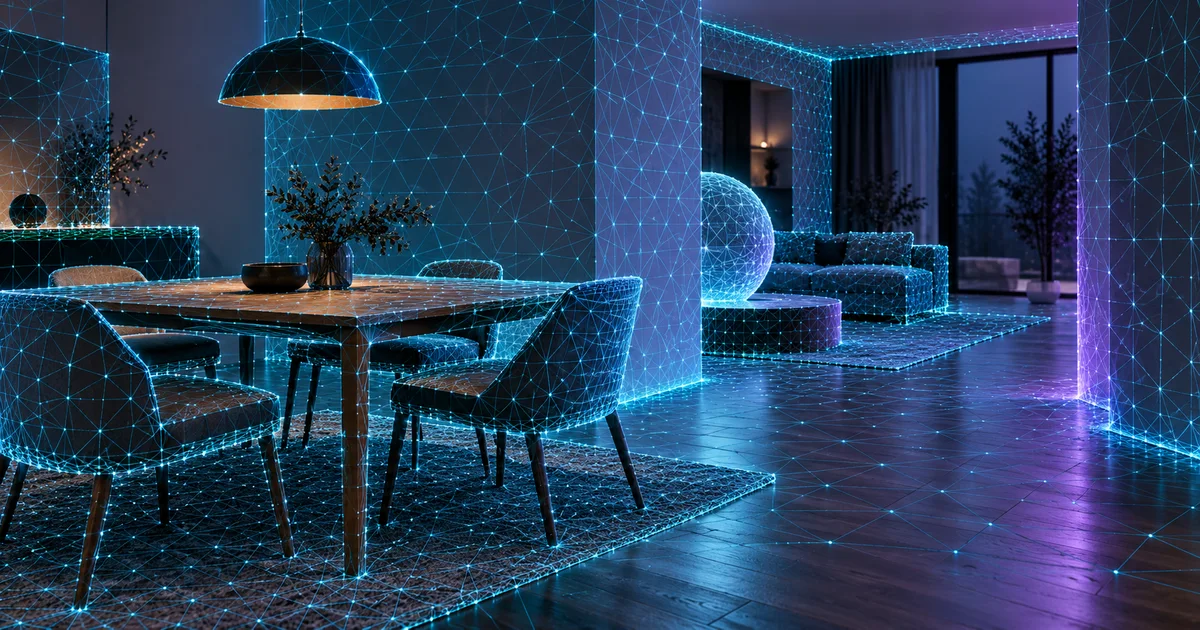
LiDAR allows you to estimate the geometry of the environment and combine plans, people and virtual content. See capabilities, limits and criteria for business use.
Direct answer
ARKit can provide a polygonal mesh that estimates the shape of the environment when scene reconstruction is supported and enabled. Plane detection smoothes portions of the mesh recognized as flat surfaces, and person segmentation can remove overlapping regions to prevent the body from being incorporated into static geometry. Mesh improves occlusion, raycast, and physics, but remains a dynamic estimate and should not replace survey or security protection.
Mesh magnifies non-planar surfaces
Raycasts can reach curved objects or regions of low detail that a model based solely on planes does not represent well.
Occlusion creates visual coherence
Real geometry can hide virtual content from the correct perspective, improving depth perception and believability of the experience.
People are not static obstacles
Combining segmentation avoids incorporating body parts into the environment mesh, but requires support, processing cost, and failure handling.
Estimation is not certified measurement
Edges, reflections, range, and movement affect geometry. Use appropriate tolerances and sensors when the decision involves physical risk.
Nexus Reading
Enable reconstruction only where it improves the task, detect support, limit processing, and validate occlusion and collision error at the real location.
FAQ
Does every device support scene reconstruction?
No. The application must invoke official support verification before activating the mode.
Does mesh improve raycast?
Yes. It allows intersection with non-planar surfaces and regions that simple planes do not describe.
Can it be used for security?
Not as a sole source without specific validation; the mesh is a dynamic estimate of the environment.
Essential guides to delve deeper into the decision
This editorial analysis was produced by Nexus from the official sources below, consulted on October 27, 2026. The text is original and interprets practical implications for companies.
- Apple Developer — sceneReconstruction: support, mesh, combination with planes and adjustment in front of people.
- Apple Developer — Visualizing and interacting with a reconstructed scene: mesh raycast, classification, occlusion and physics in the official example.
Date reported by main source: official documentation consulted on October 27, 2026; technical analysis.