
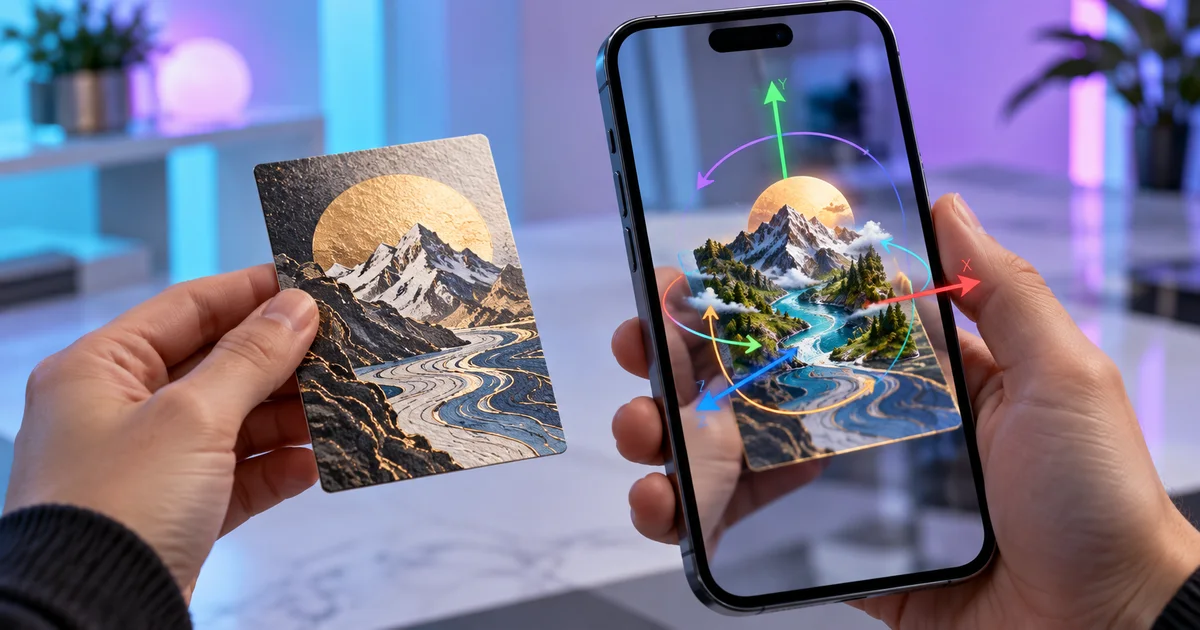
Mode tracks visible references in six degrees of freedom without full world tracking. See when to use it and how to prepare targets.
Direct answer
ARKit offers image tracking to follow known reference images that move in the camera, updating their pose in six degrees of freedom while remaining visible. Each ARReferenceImage matches the target's appearance to its physical size, and Apple recommends validating that there is sufficient visual detail. The mode has a lower cost and can track more images than world tracking, but it loses reference when the target goes out of sight; persistent content requires another design.
Moving target asks for specific mode
Packaging, card or panel held by the user may change pose continuously; image tracking tracks this change while the target is visible.
Physical dimension controls scale
Incorrect measurement shifts the distance and size of the content. Register the final piece produced, including printing variations.
Texture determines detectability
Uniform areas and repeating patterns offer few points. Contrast, detail, reflection, wear and cropping must be included in the validation.
Exiting the frame is a normal state
The experience needs to pause, hide, or migrate content when the image is no longer visible, without treating this as a silent failure.
Nexus Reading
Choose image tracking for interaction centered on the visible target; use world tracking when the experience must remain anchored after it disappears.
FAQ
Can the target move?
Yes. This mode was designed to track known moving images while they are visible.
Why provide the physical size?
It helps ARKit estimate scale and pose correctly.
Does the experience continue when the image leaves the camera?
Not for guarantee like that; persistence requires world tracking or another strategy.
Essential guides to delve deeper into the decision
This editorial analysis was produced by Nexus from the official sources below, consulted on October 24, 2026. The text is original and interprets practical implications for companies.
- Apple Developer — Tracking and changing images: image tracking, movement, visibility, cost and comparison with world tracking.
- Apple Developer — ARReferenceImage: appearance, physical dimension and validation of the visual quality of the target.
Date reported by main source: official documentation consulted on October 24, 2026; technical analysis.