
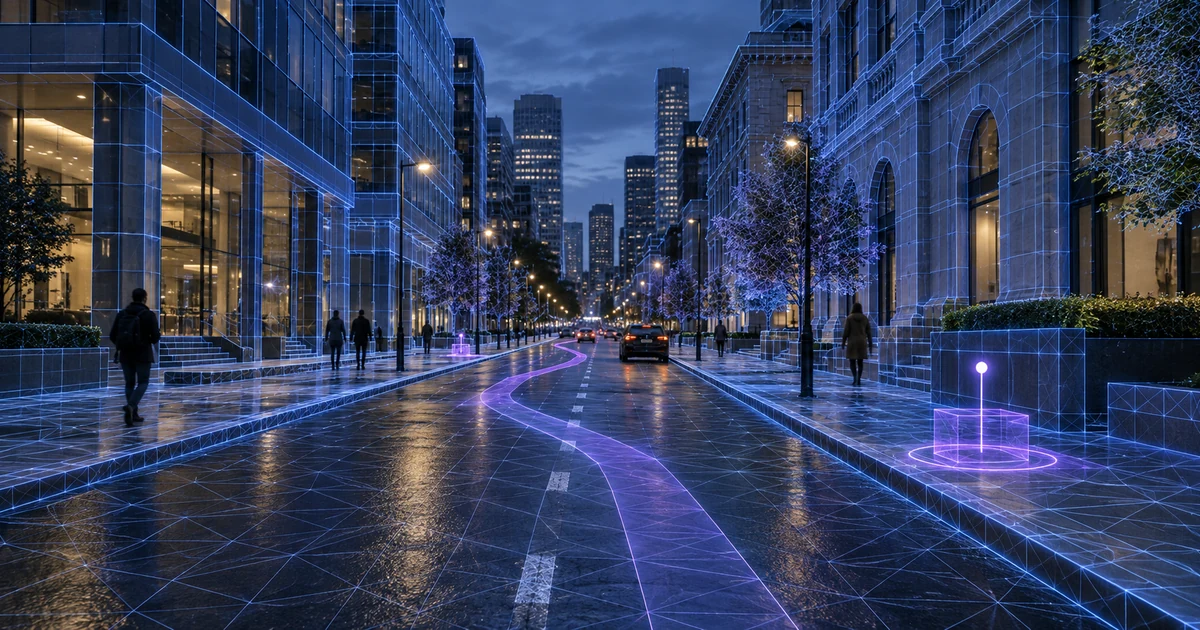
The API provides meshes of structures obtained from Street View when geospatial mode is active. See location uses, limits, and governance.
Direct answer
ARCore's Streetscape Geometry API provides geometry of terrain, buildings, and other structures derived from Google Street View images for geospatial applications. The feature requires Geospatial API and Streetscape Geometry mode enabled. It can support navigation, planning, and external visualization, but coverage, freshness, accuracy, and occlusions vary; Applications should not treat the mesh as a topographic survey or sole source of security.
The city becomes a reference surface
Instead of positioning content just by latitude and longitude, the app can relate it to facades and terrain. This improves visual scale and occlusion.
Coverage is not uniform
Regions, dates and available details depend on the base. The product must detect absence, quality and update before offering an action.
Accuracy needs to be proportionate to risk
Marketing, tourism and guidance tolerate deviations other than maintenance, traffic or emergency. For critical uses, combine sources and field validation.
Location requires minimization
Explain why position and camera are needed, process only the scope of service and define retention. Avoid recording routes when the experience works without history.
Nexus Reading
Urban geometry opens up contextual experiences at scale. The mature enterprise application shows confidence, fallback and limits, rather than hiding uncertainty behind visual effect.
FAQ
Does the API work in any city?
There is no universal guarantee; coverage and support need to be checked on site.
Is mesh an engineering survey?
No. Use certified sources when the decision requires technical precision.
What uses are suitable?
Contextual navigation, project visualization, urban information and brand experiences with defined tolerance.
Essential guides to delve deeper into the decision
This editorial analysis was produced by Nexus from the official sources below, consulted on September 14, 2026. The text is original and interprets practical implications for companies.
- Google ARCore — Streetscape Geometry: configuration, geometry types and official usage.
- Google ARCore — Geospatial developer guide: Geospatial API fundamentals, location, and requirements.
Date reported by main source: documentation consulted on September 14, 2026.