
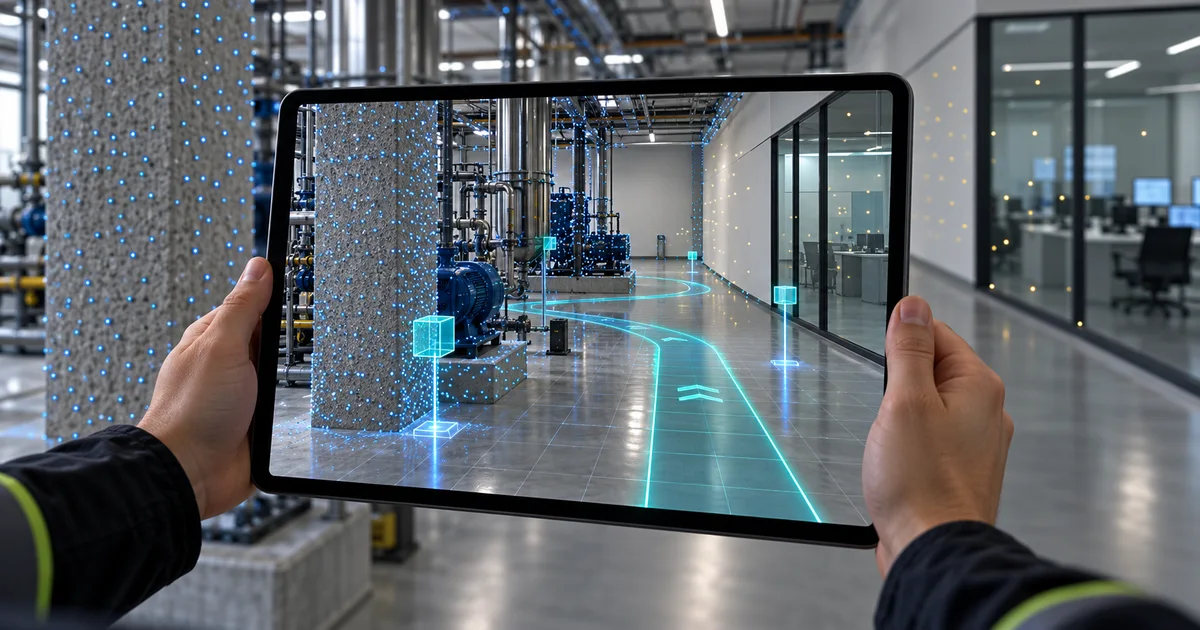
Too little texture, reflection, movement and inadequate light reduce stability. See how to prepare location, instruction, and fallback for enterprise AR.
Direct answer
AR tracking depends on the device recognizing stable visual features in the environment. Smooth or repetitive surfaces, reflections, low light, excessive motion, and objects without clear scale can reduce detection and stability. In business use, the location must be treated as part of the system: inspect it, set lighting and auxiliary markers, guide the user and maintain a safe route when the pose is unreliable.
Texture gives references to movement
Distinct edges and details help the system estimate pose. Uniform floor, white wall, and repetitive pattern offer less reliable signals.
Reflection and transparency confuse geometry
Glass, polished metal and mirrors change depending on the point of view and can produce unstable planes. Critical content needs alternative referencing.
The real world keeps changing
People, machines and moving objects change the scene. Position instructions away from dangerous routes and never use AR as the only safety barrier.
Onboarding can improve capture
Moderate movement, good light and visual cues help the user map the space. Messages should explain how to recover tracking without blaming the person.
Nexus Reading
Include the environment in the pilot's checklist: light, texture, reflection, occlusion, circulation and distance. Measure acquisition time, loss, recapture, and error by location.
FAQ
Is a white wall ideal for AR?
Not always. Surfaces with few details can make recognition and stability difficult.
Does more light always solve the problem?
No. Insufficient light impairs capture, but intense glare and reflections can also reduce quality.
How to deal with tracking loss?
Preserve state when possible, guide recapture, prevent unsafe action, and provide non-spatial fallback.
Essential guides to delve deeper into the decision
This editorial analysis was produced by Nexus from the official sources below, consulted on October 18, 2026. The text is original and interprets practical implications for companies.
- Google for Developers — Design for the environment: characteristics of space, surfaces, lighting, movement and limitations of perception in AR.
- Google for Developers — Fundamental concepts: motion tracking, environmental understanding, anchors and official ARCore principles.
Date reported by main source: official documentation consulted on October 18, 2026; technical analysis.