
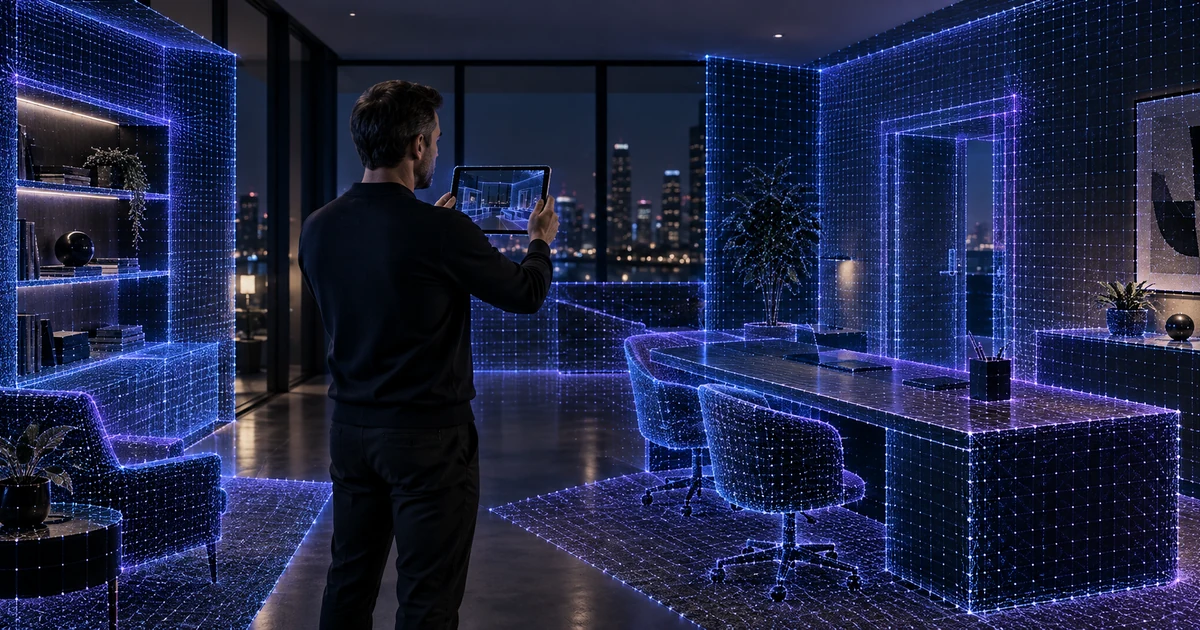
Apple's framework combines camera, LiDAR, machine learning and RealityKit to recognize walls, openings and objects. See enterprise applications.
Direct answer
RoomPlan is Apple's framework for capturing a room and producing a structured 3D model using a camera, sensors, LiDAR, machine learning models, and RealityKit. It identifies walls, windows, doors, openings and furniture categories while guiding the user. Output speeds survey and setup, but critical measurements, complex geometry and hidden conditions still require professional validation.
Structure is more useful than an isolated cloud
Recognizing walls, doors and objects allows business rules, search and editing. The model is no longer just visual and can feed layout, budget, inventory and experience configuration.
Orientation during capture reduces error
Real-time overlays show progress and prompt new angles. This makes the operator part of the quality pipeline, but the interface must explain coverage without inducing false precision.
Each use requires different tolerance
Preliminary planning, retail and visualization accept different engineering, construction or safety margins. Before the pilot, define what the measurement can decide and when a manual check is mandatory.
Privacy follows the map
A scan reveals floor plan, objects and circulation. Consent, storage, transfer, deletion and access need to be treated as environmental data, not as a simple promotional image.
Nexus Reading
RoomPlan reduces the cost of spatial input. Value arises when capture connects to catalog, configurator, digital twin or field stream with clear responsibilities.
FAQ
Does RoomPlan work without LiDAR?
Experience and compatibility are device dependent; Projects must check Apple's official matrix.
Is the model suitable for executive work?
Not without proper validation. It is excellent for surveying and viewing, but is not a substitute for certified measurement.
What formats and integrations to use?
The output must be normalized according to the destination, maintaining units, semantics, version and origin of the capture.
Essential guides to delve deeper into the decision
This editorial analysis was produced by Nexus from the official sources below, consulted on September 13, 2026. The text is original and interprets practical implications for companies.
- Apple Developer — RoomPlan: official view of the framework, sensors, recognition and capture flow.
- Apple Developer — RoomCaptureSession: session control, states and customization of the scanning experience.
Date reported by main source: documentation consulted on September 13, 2026.