
Apple documents 4K distribution for content captured at 8K per eye and 90 fps. Understand the technique and how to validate quality in VR.
Direct answer
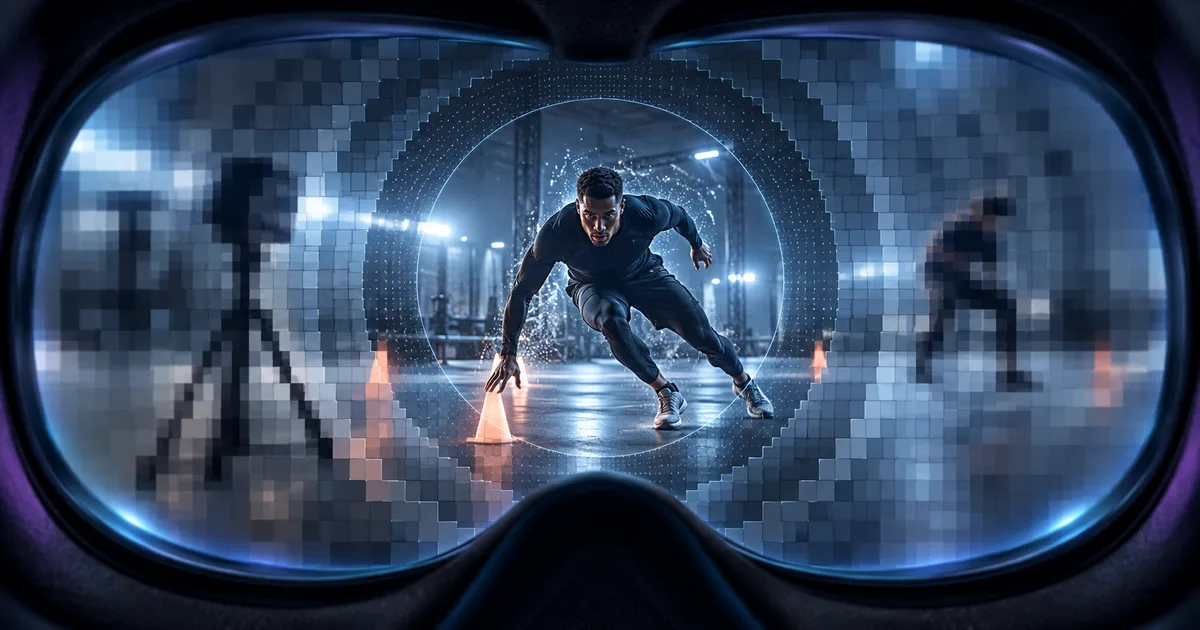
Distribution with static foveation concentrates more pixels in the perceptually priority region of the image and reduces resolution in peripheral areas. According to Apple, this allows it to package Apple Immersive Video captured in 8K per eye at 90 fps into a more viable 4K frame for streaming, while preserving much of the perceived sharpness.
The distribution problem
Apple says its immersive format can capture 8K per eye at 90 frames per second, exceeding 10 billion pixels per second. Transmitting this volume directly is impractical for typical networks, and reducing everything evenly sacrifices important details.
How static foveation works
The technique reorganizes the frame's pixel budget: it preserves more information in the central area of the lenses and less on the periphery. Unlike dynamic gaze foveation, the distribution is defined in the content and can be prepared before delivery.
Quality needs to be tested on the headset
Rated bitrate and resolution reveal no peripheral artifacts, stitching, movement, or discomfort. Validate fast scenes, contrast, text, camera cuts, and different network speeds on the end device.
Enterprise applications
Technical visits, observational training, industrial demonstrations and events can scale when high-presence content fits into predictable distribution infrastructure. The design must consider downloading, caching, offline playback and field support.
Nexus Reading
In immersive media, efficiency isn't just about compression: it's about directing quality to where it produces insight and learning. A good pipeline balances capture, encoding, network, device, and experiment objective.
FAQ
Does static foveation use eye tracking?
Not necessarily. It distributes pixels in a predefined way in the content.
Is the final video still in 8K per eye?
The source describes a 4K frame distribution that preserves priority perceptual acuity.
How to evaluate the technique?
Test center sharpness, peripheral artifacts, motion, bitrate, and comfort on the target headset.
Essential guides to delve deeper into the decision
This editorial analysis was produced by Nexus from the official sources below, consulted on September 9, 2026. The text is original and interprets practical implications for companies.
- Apple — What’s new in Apple Immersive Video: official capture parameters, foveated distribution and portals.
- Apple — Build next-generation experiences with visionOS 27: Official context of the immersive pipeline in visionOS 27.
Date reported by main source: visionOS 27 technical documentation consulted on September 9, 2026.